
I was reading my post on Car Buying yesterday. I was quite impressed with my advice, but I realized I was missing something. The post has lots of tips for when we go to a dealer to buy or when preparing for the dealer visit, but I didn’t talk at all about choosing a vehicle.
Background
I spent about 6 months after my retirement working at a national used car dealership as a salesman. I’ve always loved cars and thought it would be fun. It was and I met a lot of nice folks – co-workers and customers alike.
And while the whole sales process was time consuming and sometimes intense, for many folks, the process of choosing a vehicle could be (and should be) a lot more time consuming.
Brands
Most of buyers were looking for Chevy, Ford, Honda or Toyota, but there are lots more brands to choose from.
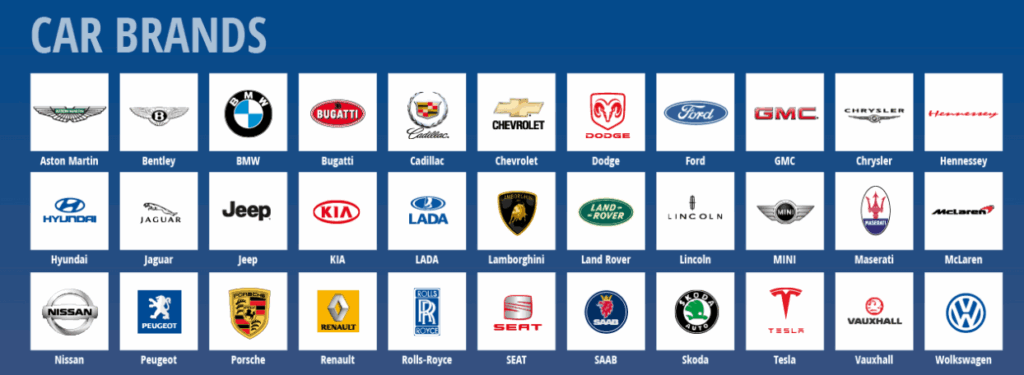
And here’s a fun brand fact. Ram is no longer part of Dodge. They split back in 2010, though many still insist on calling the pickups Dodge Rams.
Even car guys get this wrong

Here’s more on the split. It was part of the restructuring after parent company Chrysler went under in 2009. Read at slashgear.
…and we’re back…but the point is there are dozens of brands to choose from and then dozens of models within some brands.
Toyota has quite a few.
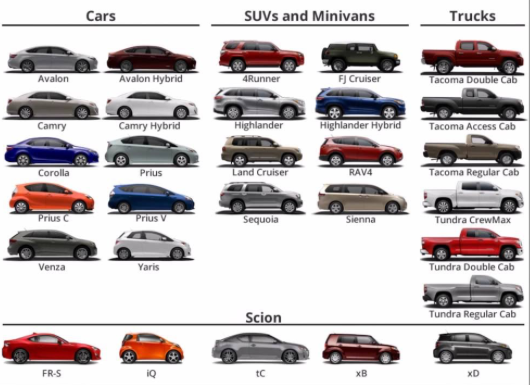
Toyota also owns the Lexus luxury brand so we could add those as well.
And don’t get me started on foreign options. Most car companies build specific models for specific regions. GM makes it’s Holden brand in Australia. You can’t get one in the US. Check it out here.
That’s why traveling in Europe, you’re likely to see a Ford logo on a car you’ve never seen before.
This is often because of local regulations, but one key factor in Europe is that the streets are much narrower than the US. Many of our cars just won’t fit.
The point is, that as a buyer, we have a lot of choice.
Make a List
Our regular readers know that this is my go-to advice.
It always works.
In this case, we want to list our requirements.
Before we jump to “I have to have an SUV” (yup, I’ve heard this a lot) let’s talk about why?
The answer is often that I have a lot of stuff.
Well, large sedans have a trunk. Your stuff is locked and hidden. And it gets better gas mileage (usually) and it is typically lighter so less wear and tear, meaning you’ll replace tires (among other things) less often. And since everyone wants an SUV, you may find a better deal on a sedan.
I’ve also heard folks say they need a 7 seat SUV because relatives visit periodically. That’s a heavy vehicle to drive back and forth to work every day with 1 passenger for the 3 days a year when you’ll need 7 seats. There are other ways to solve this. Get a zipcar for a couple days or a couple hours.
I have a cousin who is on the opposite end of the spectrum. He called me and said he needed basic transportation. He didn’t care about color, make model, options…he just needed something to get him to work and back cheaply.
Spend some time and think about what you really need.
Want
This should be a second list. I’m a car guy, so I always have a want list ready to go.
In Florida, I rented a car with smart cruise control. My car at home doesn’t have this. In an ironic turn of events, my $30,000 rental Hyundai had this and my $60,000 BMW did not.
Anyway, the system was amazing. It followed the car ahead, coming to a complete stop when it stopped, starting again when it started up. It navigated turns seamlessly. At first, I was suspicious, but after watching closely, I started to get comfortable and let the car do it’s thing.
This is not a must have for me, but it is high on my want list for my next vehicle.
But, think about this and make a list.
I’m constantly shopping for my next vehicle, but if you’re less obsessed, it may be helpful to visit some vehicle websites to get an idea of what’s available.
I will say that one of the most common complaints is folks saying they wish they had sprung for more options. Knowing what’s available and making a list of needs and wants can help avoid this.
Reliability
This is my opinion, so take it with a grain of salt (or 2).
I grew up in the 60s and 70s and in our family it was often a crapshoot as to whether our family Saab and Volkswagen would be willing to start when we needed to go somewhere. Odds were poor on a cold morning, but in the summer, more often than not, they’d turn over with a little encouragement. I learned to hold down the gas to open up the carburetor without pumping, which would flood the engine.
Carburetors are out and fuel injection is in. Transmissions are electronic – fewer moving parts. And after more than 100 years of building cars, we’ve figured a lot of stuff out. Most cars are pretty reliable.
My daughter bought a Jeep Cherokee. Jeep is a well-loved American brand that is not known for reliability. She has not had a single problem in 5 years.
My wife and I own 3 BMWs. Another brand known for frequent and expensive repairs. I have to hide my face when I walk the dog past my mechanic down the street. I haven’t brought any of the vehicles in for service in years. (I do my own oil changes – don’t skip these).
I recognize that German luxury cars can be over-engineered, while the Japanese have nailed simplicity and quality. And I know that more features means more things that can break.
But reliability is so much better today, we’re generally not making a decision between a car that will start most days v. one that will look pretty in the driveway.
Try it On
Many of my friends and customers laugh when I tell them to try on a few cars before buying.
I just bought a new pair of sneakers. I bought 3 pairs from Amazon (all under $50), wore them around the house a bit and sent 2 back. I did the same when buying a $30 pair of pants.
Why wouldn’t I try on a few when buying a $50,000 vehicle that I’ll hopefully wear for 10 years.
I picked up a friend one day and while driving, she commented that this was the most comfortable seat she’d ever been in.
Look around – we’re all shaped differently. A Toyota Camry is a great choice, but it’s not going to fit us all the same.
Subaru is a good choice and it tends to sit up a bit higher. When a height-challenged customer came into the shop, I would encourage them to try on a Subaru, even if they had no intention of buying one.
How’s the driving position, do you need to lean forward to see if cars are approaching, can you reach all the controls?
I had a car I loved, but I had to stretch to press the skip to next song button. Drove me nuts.
My current car has a blindspot in the driver’s side mirror. This would be a disaster if I didn’t have the little yellow light that tells me there is a car there. If I had noticed this when I tried it on, I might not have bought.
I had a lot of folks come in for Toyota Highlanders. Toyota is a top-notch brand and the Higlander gets good marks from Consumer Reports. But many find it uncomfortable to drive for long periods. I would ask customers to try on a Hyundai Tucson. Many found it more comfortable and ended up buying even though they’d never heard of Hyundai.
Wrap Up
In my wife’s family, you bought a Toyota Camry. There was no discussion, no decision to be made, you just bought it and moved on. Not a bad choice, but it’s important to recognize there are choices. And when we’re paying a large chunk of change and we’re going to own a vehicle for many years, it’s important to buy one that will make us happy.
My wife’s first new car was a Camry. She now has 2 BMWs. Her brother has a RAV4 – stayed in the Toyota family but expended his horizons. Her other brother has a RAV4 as well and prior to that had a Tundra.
There are lots of choices. A little time, leg-work, and trying on before making a decision could lead to a much happier ownership journey. And once you’ve decided, re-read here for some tips to turn the dealership experience in your favor.
Or check out the car section of the blog for everything from extended warranties, to car buying on Amazon, to cleaning your vehicle once you buy.
Good Luck!