

I’ve written a bit about car buying, here and here. To many people, buying a car tops their list of things they hate most. I understand why. There’s the pressure, the negotiation, the air of superiority many salesman have… Not fun.
I worked for a car dealership that wouldn’t negotiate price. Many people found that attractive.
So how about if you hade that level of stress going to the grocery store, or the auto parts shop, or the butcher. I’d like 3 pounds of sirloin. Great! How much are you willing to pay?
I’ve already lost my appetite.
Surveillance Pricing
While we may get a kick out of the idea about negotiating with our butcher, surveillance pricing is real. Basically, this means that online shops are using all the information they can find on us (and these days that’s lots) and using that to assess what we’d be willing to pay.
There are no price tags online. I pick up a pair of wiper blades at the parts store and $29.99 is stamped on the package. You pick it up, you see the same price. But what’s to stop amazon, home depot, or even my beloved ocean state job lot from displaying a different price for every shopper?
It’s just a web page. They can show any price to any viewer.
And they do.
Criteria
So how do they decide?
Let’s say I was just online at BMW of Shrewsbury checking out the new inventory. Then I go to Amazon to buy some new shoes. Amazon could take a look at the cookies on my computer and see that I’ve been shopping for BMWs and decide to ratchet up the price.
And it’s not just the cookies on our device. Online retailers can build a pretty robust profile using prior purchases, credit card data, credit scores, home value, cars registered to us…the list goes on and on. If it’s online, they can get it.
What Can We Do?
I’m glad you asked.
I talked about VPNs in a couple of posts. Read here.
A VPN is a virtual private network. Think of it as a tunnel between our device and the website we’re visiting. It protects the traffic, but it also hides our identity. When we type in www.amazon.com, the VPN intercepts this and then makes the request to amazon from its own server. When the request comes back, the VPN passes the request on to us. Amazon has no idea that we are on the other end.
Apple’s private relay performs a similar function.
We can also use incognito mode on our browser. While this is often less anonymous than a VPN or private relay, it does provide a level of protection.
Consumer Reports
And if you really want to put an end to this. Consumer Reports is starting a petition.
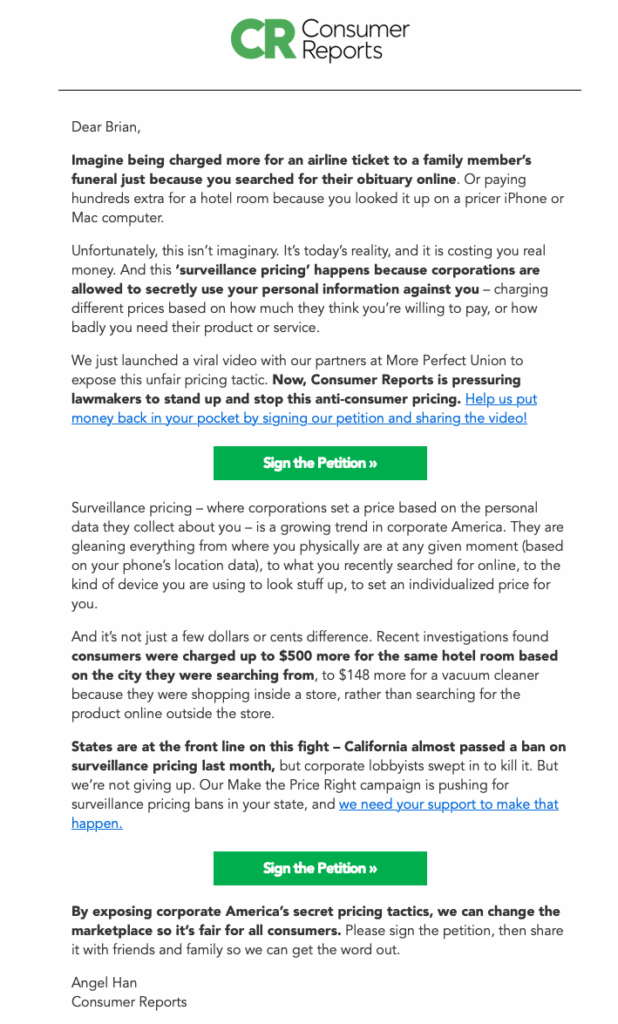
Click here if you’d like to add your name. I did.
Wrap Up
At least the car salesmen are upfront about this. We know there will be a negotiation and they don’t try and hide it. Surveillance pricing online is a little more frightening.
I know that my SSN is out there. I also know that the credit agencies like Experian, Trans Union and Equifax, who gather my credit history are selling that information to whoever is interested.
The internet has made our lives easier, but it has exposed our financial lives.
And unfortunately criminals and retailers (it’s sometimes hard to tell the apart) are using this info against us.
At least now we know, and there are a few things we can do about it.
All your data is embedded in π
Everything.
But don’t worry, it’s encrypted.