
I’ve become a big fan of covered call options. They have a small but important place in my investment strategy.
A covered call option is a contract we sell to another investor that allows them to buy a security that we own at a specified price on or before a specified date. A single covered call option covers 100 shares so we need to have those shares in advance of selling the contract. And we get a small premium in return.
Example
On February 19, 2026, I sold -CAT260417C770
- Option symbols start with “-“
- CAT is the symbol of the underlying security on which the option is based. In this case CAT (Caterpillar)
- Next comes the expiration date – 260417 is April 17, 2026
- C means a call option (P would be a Put)
- 770 is the strike price
By selling this option, I have given another investor the right, but not the obligation, to buy 100 shares of Caterpillar from me at a price of $770 per share on or before April 17, 2026.
After April 17, the option expires and we go our separate ways.
Covered
Call options don’t need to be covered. I don’t need to own the 100 shares to trade the option. If I sell a call option and I don’t own the shares, that is what’s known as a naked call. I get the initial premium, and I am obligated to sell 100 shares at $770 per share if the option buyer exercises the option.
Imagine Caterpillar continues its winning streak and the price goes to $1,000 per share. I would have to buy 100 shares at market price and sell them for the contract price of $770. I’d lose 1000 – 770 = 230 per share x 100 shares = $23,000. Yikes!
And since the theoretical upside on Caterpillar is unlimited, my loss could be unlimited. I wouldn’t touch a naked call with a 10 foot pole.
With a covered call, I own the shares in advance. In most cases, I buy 100 shares and immediately sell a covered call option for a strike price slightly higher than my purchase price. I get the premium immediately. If the stock price moves above the strike, I sell my shares at a small profit, if it stays below, I keep them and maybe hold them, maybe sell another covered call. Read more details here.
Risks
Sounds good but there are 2 big risks with covered calls.
- The price of the stock I bought could plummet. This can happen with great companies. I bought 100 shares of Amazon a few years back and sold a covered call. The share price immediately dropped 40%, and stayed down for about a year. Amazon is a high conviction stock for me so I had no problem hanging on, but a small premium can’t make up for a large capital loss.
- Our gain is capped. Our biggest investment gains come from companies or funds that double several times or more. When we sell a covered call option, we commit to selling at a set price. If our underlying company doubles, we lose out on that gain because we are contractually obligated to sell at the contract strike price.
I take a small percentage of my equity portfolio and use it for covered call options. I do not sell covered calls on the majority of my holdings because I rely on the long-term capital gain potential.
The Other Use…
OK, right.
I wrote earlier this year about my dilemma with Caterpillar and Cummins. They are 2 companies that I love, but they are boring old industrial companies that have been on a tear. They were both up double digits last year and started strong again this year.
I thought about selling and taking some gains, but I couldn’t do it because I remain optimistic about both. You can read more here and here.
So while I didn’t want to sell the shares I had, I decided to sell a covered call option on my Caterpillar shares instead.
Here’s where Caterpillar was on 2/19.
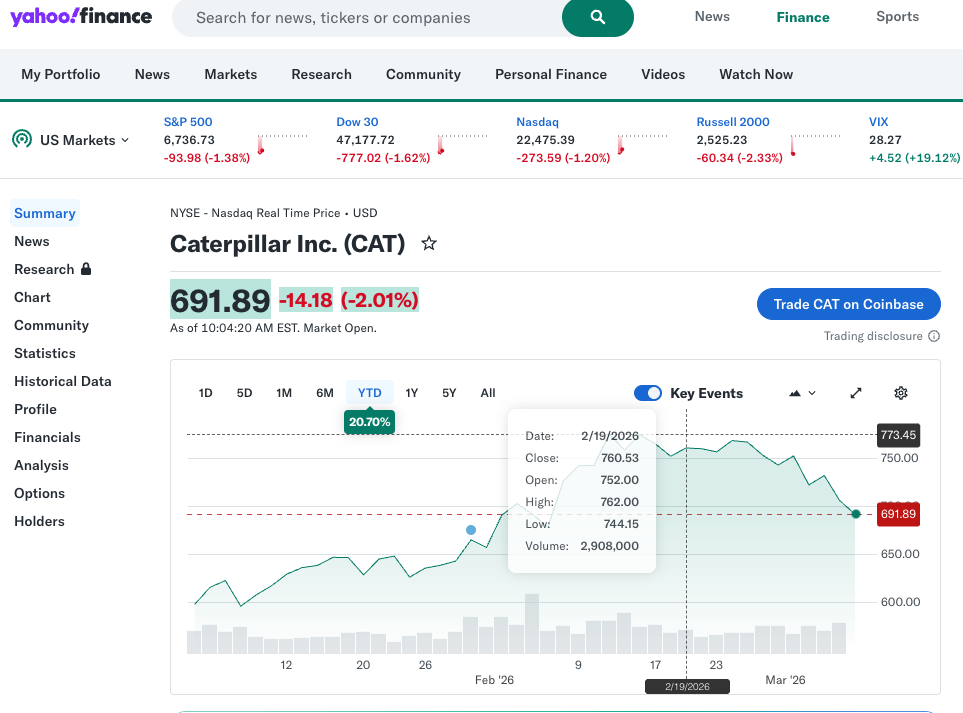
I bought my shares in September of 2023 for $261. I didn’t want to sell for $760, but at $770, I get an extra $1,000 if I sell, and I’ll get the premium, which for the 770 strike on April 17 was $3,759.
And I really didn’t expect Caterpillar to get to $770.
But then again, In January I didn’t think it would keep going up…
I know better than to bet on short term moves. Because it’s a bet and that’s gambling and we don’t do that with our investments.
Happy Either Way
So I’d be happy holding Caterpillar forever, especially since I’m putting an additional $3,795 in my pocket, and with my $261 per share cost basis, I can weather a pullback in the stock price.
I’d be happy as well if Caterpillar pops above $770 and I keep my $3,795, and I take a 770 – 261 = 509 per share gain for my 100 shares so $50,900. Pretty sweet.
Wrap Up
So, this was something I’ve not typically done.
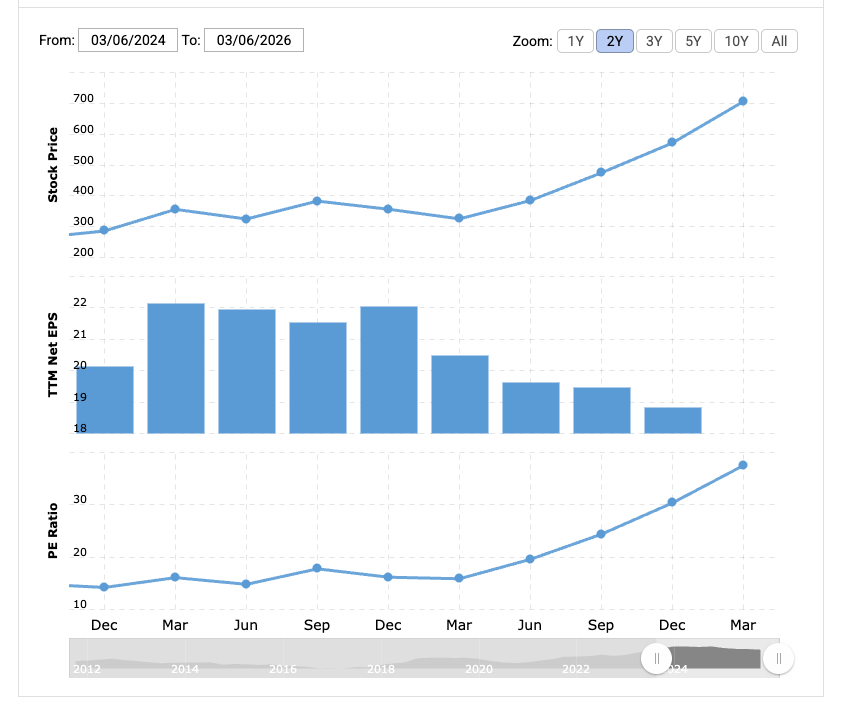
But as I thought about my shares of Caterpillar, I felt like the price had gotten ahead of the value. My original shares are up over 140% in a little more than 2 years. That’s a little extreme for a boring industrial company.
Check out the 2yr P/E history. Yikes. Price heading up, earnings down.
I’m not ready to sell, but selling becomes more attractive if I could get an almost $4,000 premium, plus a $1,000 cap gain and then I could buy shares of Caterpillar at the next pullback.
Or better yet, I could take the premium and keep the shares if the stock price pulls back.
Winner winner chicken dinner.