

I’ve written a few posts – check out the list here – about covered call options. If you’re unfamiliar with covered call options or you’d like a refresher, this is a good place to start.
For those who can’t bear to click, when I sell a covered call option, I am taking a small premium from another investor in exchange for the right (but not the obligation) to buy a specified security on/or before a specified date, at a specified price.
And since I only trade covered calls, I buy the security before ever selling the call option.
For example, I sold -OZK260515C52.5. I got $1.99.
But let’s dig in a bit to see what that really means.
- On 7/14/2025, I bought 200 shares of OZK for $52.36 per share. This cost me $10,472.
- Options are sold on lots of 100 shares, so I was able to sell 2 covered call options on my 200 shares
- The $1.99 that’s quoted is per share. I got $199 for 100 shares, and since I sold 2 options, I got $398.
- 398/10,472 =0.038 that means I got a 3.8% return.
But There’s More
If you’re reading closely, you’re wondering why I bought shares in July of 2025 – almost 9 months ago – sold a covered call option with an expiration of May 15, 2026, and only got $1.99 per share.
That 3.8% return is nice for a month or 2 of holding the shares, but not as exciting if I need to hold for almost a year.
Here’s the Whole Story
I bought the shares in July of 2025 and immediately sold a covered call option on all 200 shares, with an expiration of August 15, 2025. I got $2.22 per share in premium, so $444 in total for 200 shares. That’s a 4.24% return for holding the shares for 1 month.
And on August 15, 2025, OZK closed below $52.50 per share so the option contract expired and I kept my 200 shares.
Here’s a snapshot from my option tracking sheet. I record the option contract as well as the share purchase (200 shares of OZK bought on 7/14/25) the option was sold against. I checked the expired box because I still own the shares.

Sell It Again!
Unfortunately, OZK had closed at $49.32 per share on 8/15/25. The good news is I kept my shares and my premium. The bad news is that my shares have decreased in price from $52.36 per share to $49.32. That’s a roughly 6% dip.
Not awful since I love the company, but not great because no one is going to be wiling to pay $2.22 for an option to buy at $52.50 one month from now.
I have 3 choices
- Accept a lower strike price to get a higher premium. I never do this. This guarantees a capital loss!
- Extend the date of the contract – longer time is more risk so people will be willing to pay a higher premium.
- Let OZK sit in the penalty box until the price recovers, and collect a nice 4% per year dividend while I wait.
As enticing as #3 is, I already hold quite a few shares of OZK long (not covered) so I opted for 2.
I got $2.28 per share for a January 16, 2026 expiration with the same $52.50 strike price. The same roughly 3.8% return on the option premium, but now that’s spread over 5 months instead of 1.
Also note the Prior Option Income column. I’m automatically including the prior income I got for shares of OZK matching on Underlying Security and Share Purchase Trade Date.

Rinse and Repeat
Same play in January.
OZK price is below $52.50. It’s closer to $48. I keep the premium and keep the shares.
I sell a May 15, 2026 covered call option. This is where I get the $1.99. This time for a 4 month duration.

And you’ll see the prior option income column now accounts for the 2 prior sales.
Recap
Let’s recap.
It’s important to understand that I only bought the shares 1 time. My total investment is 200 shares at $52.36, so $10,472.
As a shareholder of OZK, I’m not thrilled because $52.36 was a peak. It hasn’t been back there for a while and has mostly stayed around $48. Today on April 6, 2026, it’s at $46.94.
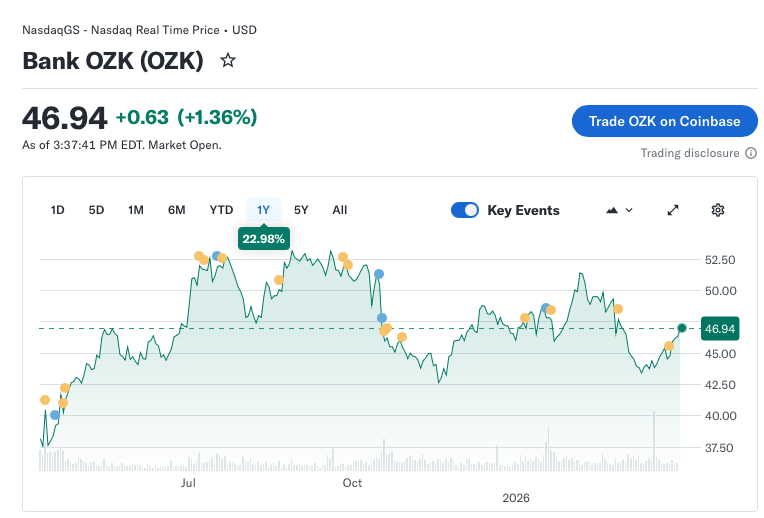
My $10,472 investment is worth $9,388. I’ve lost $1,084, or 10.35%.
But That’s Not The Whole Story
Don’t forget dividends.
OZK pays $1.82 per year per share in dividends. I bought 200 shares so for me that’s $364 in dividends.
I’ve also been pocketing some option premium.
Over the course of the last 9 months or so, I’ve sold covered call options in these same shares 3 time. Once for $2.22, once for $2.28, and once for $1.99. Add those up, it’s $6.49 per share x 200 shares = $1,298.
So, my unrealized capital loss (on paper only) is $1,084 but my real option premium in my pocket is $1,298. I’ve actually made money on this investment.
Another way to look at this is that every time I sell a covered call against the same shares, I’m lowering my cost basis on the overall investment.
I paid $52.36 per share for 200 shares. That’s a bummer because they’re now worth $46.94.
But the $2.22, $2.28 and the $1.99 each reduce my cost basis. So my effective purchase price for the shares is (52.36 – 2.22 – 2.28 – 1.99 = ) $45.87
Wrap Up
While we all know we need to be rationale, we also need to accept that emotion drives a lot of our decision making.
When we see our investment has lost money, it haunts us. I was haunted this morning when I looked at my OZK shares and realized I was down 10%. Did I make a mistake? Should I sell?
But what my broker doesn’t show me on my positions page is the net result of all of those option sales. Luckily I track this myself.
If I scroll to the right on my spreadsheet, I can see that I’ve sold options on these shares 3 times and that the $6.49 per share in option premium has reduced my cost basis to $45.87.

Knowing that sometimes we can be emotional about decisions, it’s important to have the right information.
While I use covered call option premiums for income, it’s important for me to record-keep my option income and my dividend income associated with each share purchase so that I have accurate and complete information when evaluating a position’s performance.
Note on Dividends: While I mentioned the $364 in dividends I received on my OZK purchase, I did not include it in my cost basis calculation. This is intentional because cost basis is different depending on whether our account is taxable or tax advantaged. This topic needs a whole post of its own, for today, the $364 is important to be aware of, but I’ve excluded it from the cost basis calc.