

Today I was thinking about a few of my recent posts and some of my classes, and I was thinking about some simple ways to jumpstart savings. It’s easy to put off saving or investing. We want to wait until we have more money, or more time to look into it, or…you name it. We’re busy. It’s easy to put this off. So today I’d like to take an example of how we can take a small step that can have a meaningful impact.
But First…
I’ve presented a handful of sessions at Women’s Money Matters and I have been inspired by the women who attend and who are trying to learn about personal finance and improve their financial health. At last night’s class, I spoke with a young woman who had changed banks to save on fees and was looking for an alternative to money orders so she wouldn’t have to pay the $3 every time she paid her rent. I’m with you Ayanna! I just shut off auto-pay on my water bill because their new system charges me a $3 convenience fee each month. Convenient for who???
And during the break I was trading saving tips with another young lady. She told me about Target coupons and I told her about the Ocean State Job Lot Crazy Deal.
It was inspiring to meet folks who were focused on saving and improving their finances.
And once we start saving – even a few bucks – it’s not that hard to put that money to work to invest in our future.
Saving
It all starts with saving. I’ve written about this here, here and here. I recently saved over $400 per year by changing my cell phone plan. Read about it here.
And, a few bucks can make a meaningful difference. That’s what we’ll look at today.
So for today, I’m going to challenge each of you to find some savings and come up with $10 per week. That’s $2 per day. Think you can do it?
Investing
Last night’s class focused on bank accounts. We looked at a Bank of America account that paid 0.01% interest and an Ally High Yield savings account that paid 4%. We talked about how anything less than 2% will lose buying power to inflation because inflation averages 2% to 2.5% per year so if we are not growing our savings by that much, we’re losing purchasing power. We’ll still have the same $50 to take to the grocery store, but that $50 won’t buy as many groceries a year from now.
And while the 4% will compound and grow, in order to supercharge our growth, we need to look at other investment options.
Risk v. Reward
Our bank account is very low risk. Most accounts are insured by FDIC, NCUA or SIPC so that up to $250,000 will be protected if there is fraud, theft or insolvency at our bank. And while we may lose to inflation, the dollar value of our account will not go down.
However, investments like stocks, bonds, mutual funds and ETFs have no such guarantees. They have a higher potential for earnings, but there is a risk that the value of our assets can go down.
Let’s take a quick look at a company we all know. Apple has done pretty well. It’s iPhone is quite popular and it’s Apple Stores are always full. Because of this, investors who own shares of Apple have profited. Look at the stock price chart for the past 5 years.
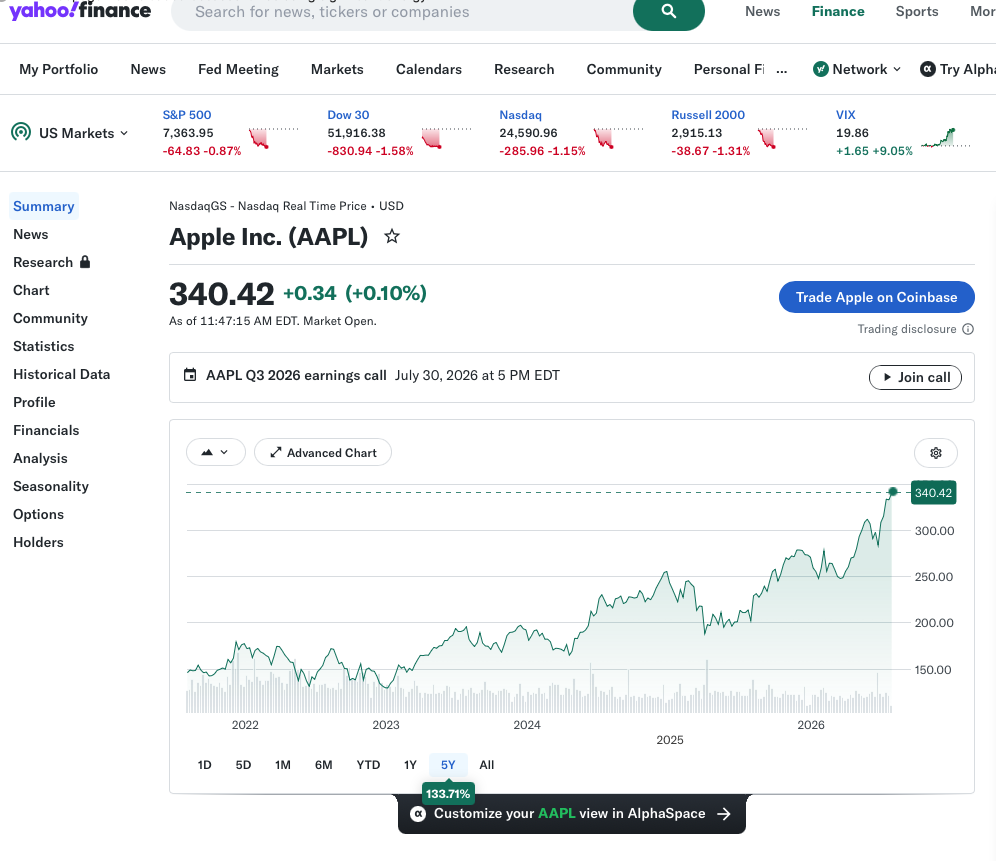
It’s up 133.71%. That means that if we invested $100 in Apple stock in 2021, we would have over $233 today. In just 5 years!
But look closely. What if we bought 1 share of Apple in January of 2025 at $258. Apple’s stock price drops dramatically and goes down to $188 at the end of March.
Looking at Apple’s chart today we can see that it went on to new highs after that, but in March of 2025, we didn’t know that. For all we knew, it could have dropped further.
Buying shares of Apple is more risky than putting our money in a bank account but the potential reward is much greater.
My $100 in Apple more than doubled in 5 years. Had I put in in a high yield savings account at 4%, I would have had $117 v. the $258 I could have had investing in Apple.
Mutual Funds and ETFs
Mutual Funds and Exchange Traded Funds minimize our risk because they buy a basket of securities. Instead of taking $100 and buying a fractional share of Apple, we could buy a fractional share of a fund or ETF that holds hundreds of companies. (I’ll explain fractional shares in a bit.)
One of my favorites is the iShares Core S&P 500 ETF (IVV). The ETF holds shares of the 500 largest publicly traded US companies. Here are its top 10 holdings.
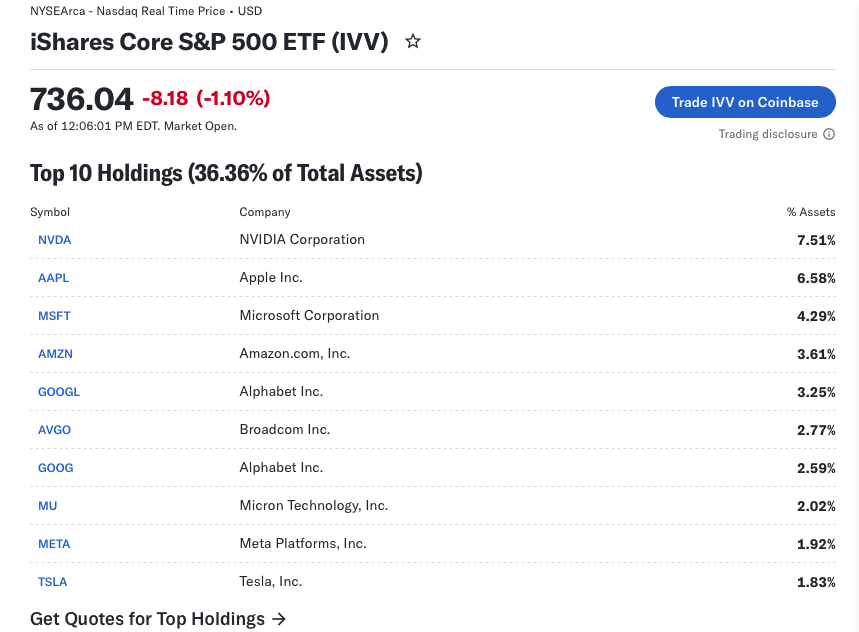
These are just the top 10. There are 490 more companies that it holds.
As an investor, we can buy shares of IVV and immediately own Apple, Microsoft, Amazon, Coke, McDonalds, Starbucks, Walmart, and many more.
And here’s a post I wrote a while back about why I think the S&P 500 will continue to help us grow our wealth.
The S&P 500
For those who didn’t click on the S&P 500 article, why do I think the S&P 500 is a good investment? Read the post to learn why, but if we look back at the last 100 years, the S&P 500 has been volatile, but it has averaged 10% returns per year with dividends reinvested. (I’ll explain what reinvested dividends are in a sec.)
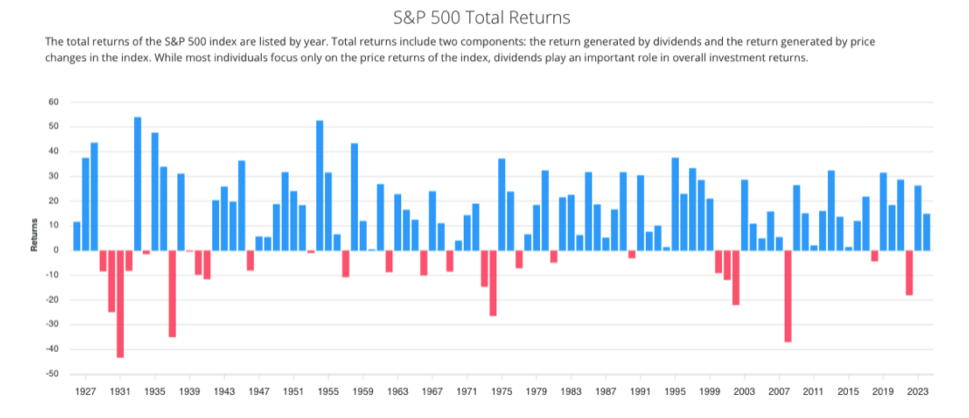
It has had years like 2008 where it was down about 40%. It has had years like the early 2000s where it was down 3 years in a row. But it is up more often than it is down and if we invest and stay invested, our odds are good that we’ll achieve the 10% average.
The Growth of Our $10 per week
So let’s look at a projection of what might happen if we invested our $10 per week. We’re young, so let’s assume we’ll invest $10 per week into an S&P 500 fund for 40 years.
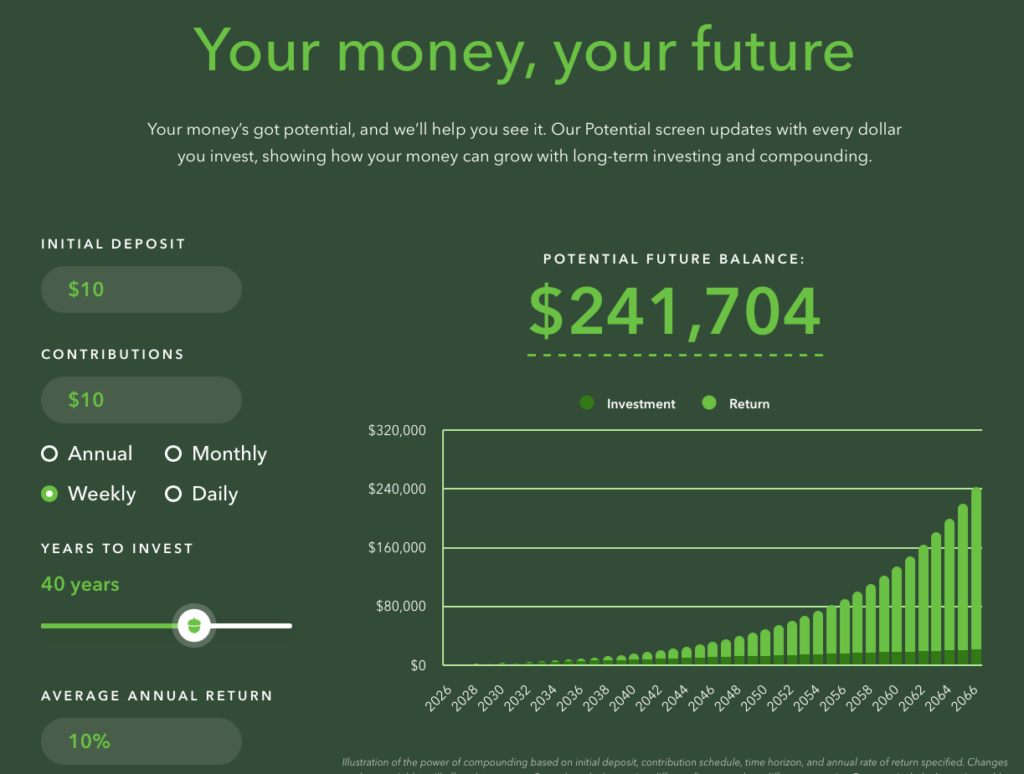
How’d you like to have $241,000 when you’re 60? Here’s the secret. Put aside $10 a week, every week and invest in an S&P 500 fund or ETF.
We’ll have years where we’re down 40%. We’ll find ourselves down for several years at a time, but if we stay focused and continue putting in $10 per week, we won’t even remember those down times.
How Do We Get Started?
1st step is to find the savings. We need to find a way to get $10 per week.
Then we open a brokerage account. It’s easy. Read about it here. This will take you 10 minutes and cost you nothing.
Then we decide how we’ll add money. The simplest way is to open up a companion cash account to go with the brokerage account at the same financial institution. We can direct deposit into this account or we can deposit a check by opening their phone app and snapping a photo.
Transfer money into the brokerage account and click trade. We fill out an online trade ticket that looks like this.
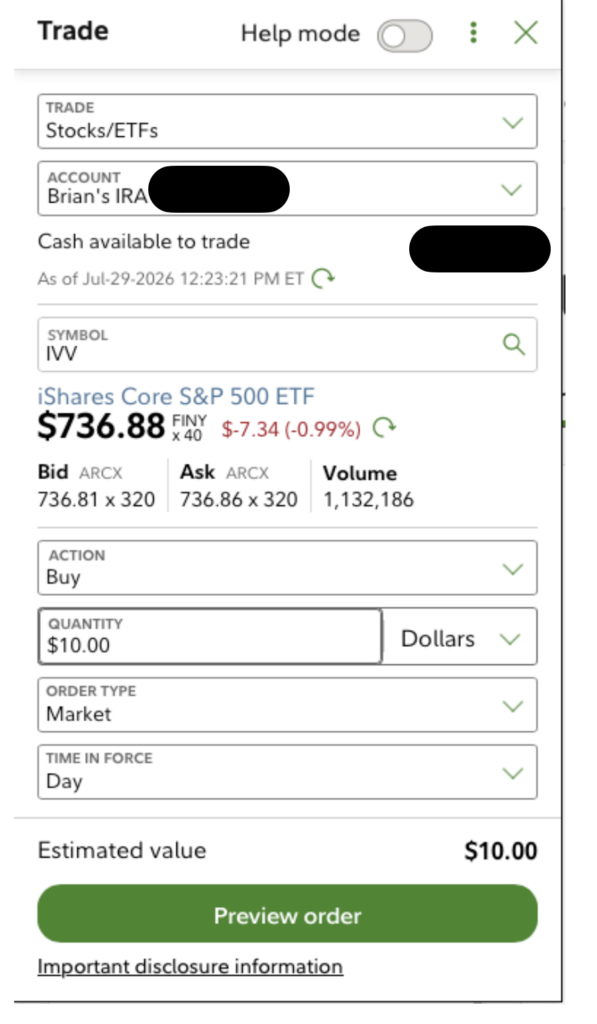
A share of IVV costs $736.88. We’ve only got $10 to invest, but fear-not. Most brokerages now allow fractional share trading which allows us to buy a portion of a share. And they are nice enough to let us choose to trade in dollars so we don’t need to do the math. I click preview order, then place trade and our broker takes $10 and buys a fraction of a share of IVV.
And once we’ve made a purchase, we’ll see this in our account. This is a sample from my account. I bought IVV in this account back in July 2024.
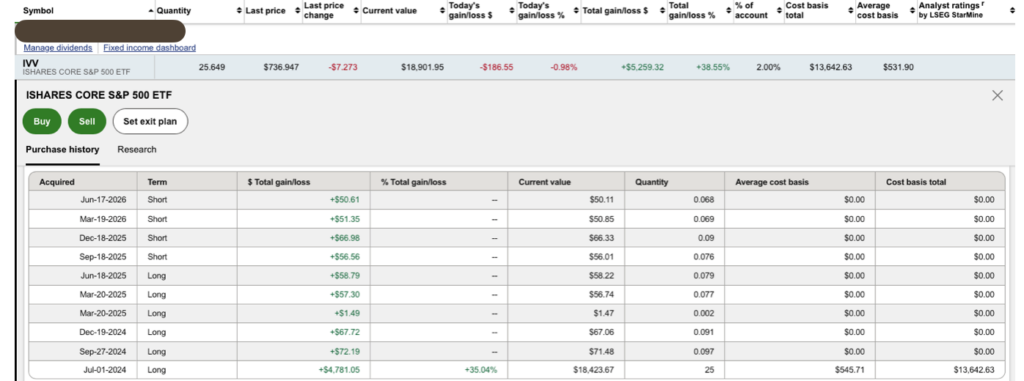
I bought 25 shares on July 1, 2025. Those additional purchases that you see above are dividend and capital gain payments. IVV makes quarterly dividend payments. We’ve chosen to reinvest dividends so instead of getting cash in our brokerage account, our broker uses the dividend payment to buy more shares. Funds typically make capital gain payments once or twice per year. We can choose to reinvest these as well.
So even though I only bough 25 shares, I now have 25.649 shares because of dividend and capital gain reinvestment.
I’m up 38% in a year and a half. That’s a lot better than a high yield savings account.
Dollar Cost Averaging
We’ve committed to buy $10 worth of IVV every month. I suggest automating this. Your broker can help. You can set up automatic transfers and automatic purchases.
The reason we want to do this is we want to buy every month whether the market is down or up. When the market is down, we’re not feeling great about investing, but our automatic purchase will happen anyway and we’ll buy shares at a lower price.
We buy regularly and it all averages out in the long run, we buy some high, some low, but in the end we win as long as we stay the course.
Wrap Up
This is a low-risk way to jump start our savings.
All we need to do is find $10 per month. And instead of spending it on lottery tickets or junk food, we’ll invest in our future.
And we know our account will go down at some point. Historically, this happens every few years, and it hurts to watch our balance drop, but in the end, we haven’t risked our life savings, we’ve risked $10 per week.
And history tells us that if we stick to the plan and keep investing $10 per week, we’ll get through those down times and end up quite a bit ahead.