

I’ve heard folks say the stock market is rigged so they believe it’s not worth investing. I think this is a mistake, even though I believe they are half right. The stock market is rigged (I’ll explain why I believe this in a bit) however, I still also believe that it is the best place for us to grow our wealth.
In doing some research for this post, I came across Is the Stock Market Rigged? Yes. And Why It Doesn’t Matter. I love the sentiment. Let’s talk about why.
Headlines
I’m not going to fuel the fire with links, but we’ve all seen the articles. Nancy Pelosi is a member of congress. She makes legislation that impacts companies that do business in the US. Yet she is allowed to trade the stocks of the companies that she regulates. Yikes!
Let’s say she and her husband Paul are chatting about their day over a nice dinner. Nancy talks about the some upcoming legislation that could impact credit card companies but is unlikely to pass. The next day, Paul buys some shares of Visa and then gets rich (richer) when the legislation fails and Visa’s price skyrockets. This is all hypothetical, but just think…
And what if the US government decided to take ownership stakes in publicly traded companies. Given that the national debt is now closing in on $40 trillion, it would be nice to see taxpayers reap some benefit from stock market gains.
But what would happen if the government took a stake in a large computer chip company, say for example, Intel. Might Intel have some advantages over non-government-owned companies in government contracts? Might our legislators in congress be more likely to write laws that favor intel?
Well, this actually happened. Read about it here. And look what happened to the stock price of Intel.
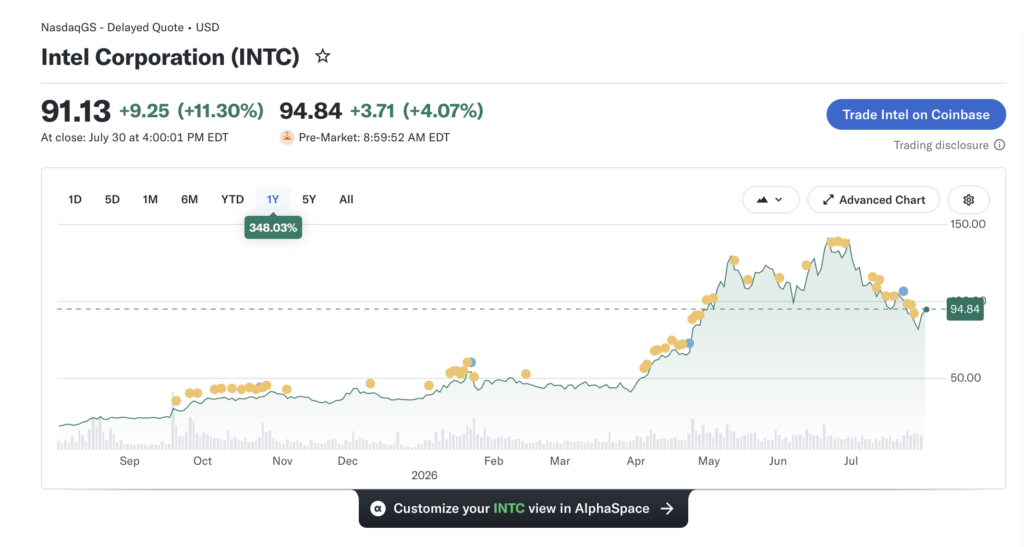
These 2 examples have been some of the bigger headlines, but there are many examples of manipulation, unfair advantages, and some downright cheating…all we need to do is hunt a bit. The media loves these because they’re great stories of the rich profiting at the expense of the little guy.
It Just Doesn’t Matter
Camp counselor Bill Murray chants “It Just Doesn’t Matter” to inspire camper Rudi Gerner in the 1979 classic film Meatballs.
I feel the same way about stock market manipulation. Here’s why.
For most of us average investors, we invest for the long-run. We tend to have a 401k at work and we hold a mutual fund or 2. Retirement plans are getting good at shepherding us to target date funds, which manage our allocation for us as we approach retirement age. We invest with every paycheck and were doing little, if any, trading.
If shenanigans in the oval office cause Intel to rise at the expense of other chip-makers like Nvidia and Broadcom, it doesn’t concern investors in a nice low-cost S&P 500 index fund because our fund owns Intel, Nvidia and Broadcom (along with 497 other companies). Take a look:
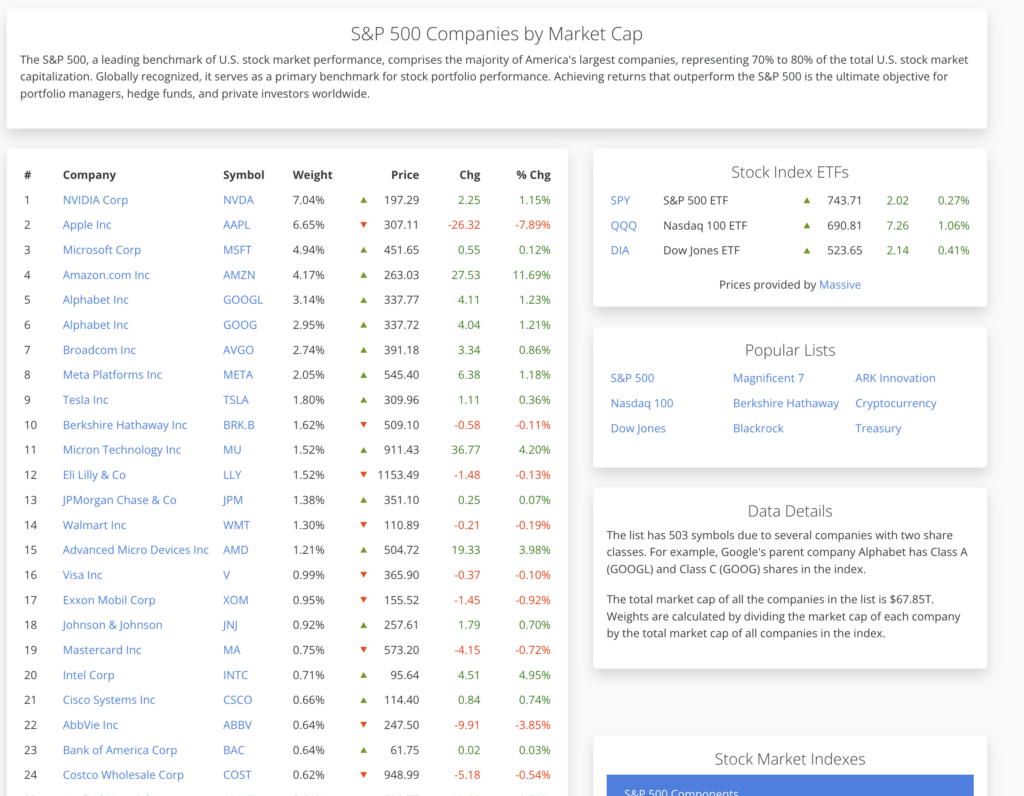
And you can see Visa at #16. If something funny is going on in the Pelosi household, we win here as well.
Winners and Losers
That’s not to say stock market manipulation is OK. I am a huge proponent of legislation that prevents our elected officials from trading stocks. And all-in-all, the Securities and Exchange Commission (SEC) does a fantastic job of ensuring the US markets are fair.
And even when there is manipulation, most long-term investors who hold mutual funds and ETFs for the long haul aren’t adversely impacted.
But there are some traders who do get whacked.
Imagine it’s a point in time just before the US government stake in Intel. Intel is a decaying company. They’ve just fired the CEO, they’re scrambling to find a replacement and the stock price is down.
There’s general consensus in the investing world that Intel is a sinking ship and it’s only going to get worse. We’re a trader who is selling Intel short. This means that we are selling shares of Intel, but we do not own the shares. This is a very risky strategy. We borrow shares and then we’re expecting to sell those shares at a much lower price in the future, and close out our short position.
Here’s an example.
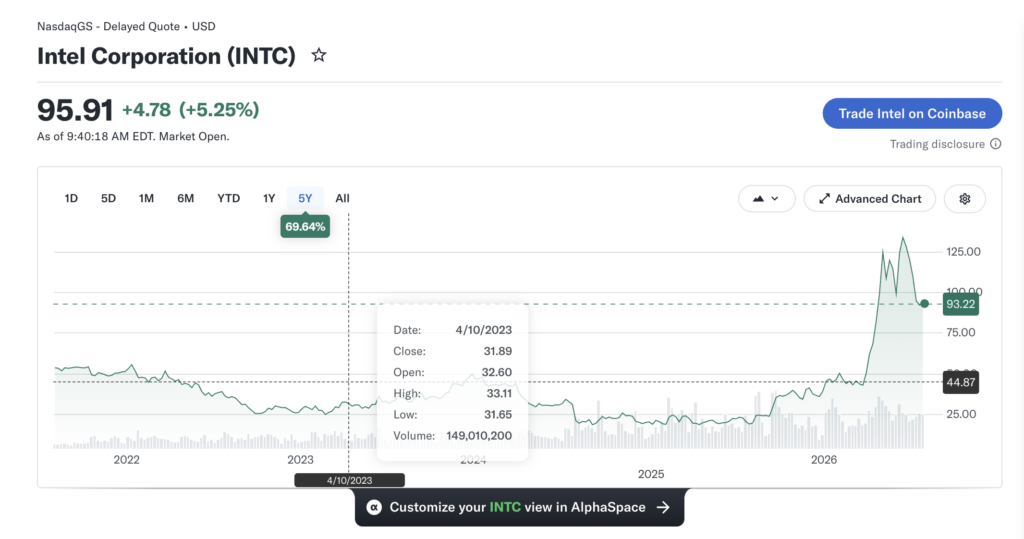
Intel is on a long downward spiral in 2023. I borrow 1,000 shares and sell them at market price $31.89 per share so $31,890 for 1,000 shares. I put the $31k in my pocket and dream of the day that Intel’s stock price gets close to zero, at which point, I’ll buy $1,000 shares, return them and make a huge profit.
Things look good at first, then there is a brief dead-cat-bounce in 2024, and then the slide continues – just as I’d planned.
What just happened??? The US Government is taking a stake in Intel??? We all know that this means the government now has a huge incentive to make Intel successful. And who better than the US government to make this happen. Maybe they’ll coerce US companies to buy chips from Intel instead of Taiwan Semiconductor Manufacturing (TSM) – who, by the way, is not a member of the S&P 500 because they are not a US company.
So as Intel jumps to $125 per share, I do some math.
- I borrowed 1,000 shares of Intel – cost me nothing, but I am required to return them at some point in the future
- I sold those borrowed shares for $31.89 per share and a total sale price for 1,000 shares of $31,890.
- I put the $31,890 in my pocket, or I invested it, or I buy a boat…
- I look at today’s price of $125 and calculate that 1,000 shares will cost me $125,000 if I buy them back and return them
- I’ll have lost roughly $85,000.
- Or I can ride it out and hope for the best – the best in this case is that something horrible happens at Intel and the stock price tanks below $31.89.
- But what if it continues to go up. My loss is unlimited.
Unlimited loss potential is a real thing. There is no limit to how high Intel can go. I am responsible for returning 1,000 shares, no matter what the price.
The point is that trading is risky. It involves bets on things that are unknown. Shenanigans by market participants can make it even riskier.
Market manipulation tends to be less impactful, or not impactful at all, for buy-and-hold investors like us. We buy a basket of stocks or a mutual fund or ETF and we add to our investment regularly. We don’t worry about when to buy and when to sell. We do this because we know the lesson of the S&P 500 which is that over the last 100 years, there have been huge ups and downs, but on average, the S&P 500 has returned 10% per year with dividends reinvested. This track record benefits investors who have held on for long periods of time.
Wrap Up
Manipulation happens. Read the articles. Sometimes it’s trading on non-public (insider) information. Sometimes it’s investors buying lots of shares to drive up the price and then selling (also known as a pump-and-dump, what a fun name).
And the folks with more money and more influence can manipulate stock prices and markets, while most of us can’t.
But despite the articles, manipulation is low compared to the thousands of securities and the millions of trades placed each day.
I believe that for buy-and-hold investors who own a basket of 20 or more well-researched companies, or who own a mutual fund or ETF or 2, the manipulation becomes meaningless in the long-run. We’re just as likely to profit as we are to lose.
This is not always true for a trader who bets big on 1 stock or who uses derivatives like options, or who uses borrowed shares to short an individual stock. These are risky strategies that are fraught with danger on their own and can be disastrous when manipulation is introduced.
So please, don’t let the fear of manipulation prevent you from participating in the US stock market. It has proven to be a fantastic wealth builder for those who are patient. And as Warren Buffet said, “If we can’t find a way for our money to work for us, we’ll work til we die.”