
I’ve written a bit about covered call options here, here and here. But here’s a brief overview.
I buy 100 shares of a company I like. This is the key. It needs to be a company I’d be happy holding for 5 or more years regardless of what the price does.
Once I own the shares, I sell the option for someone else to buy those shares at a specific price (strike price) on or before a specific date (expiration). I get a premium for the sale and if the price is below the option strike price, I keep the shares. If it’s above, I sell the shares at the contract price.
Example
I’m using Okta, an identity management tech company for my example. I hold a good-sized long position as I’m bullish on the company. I also write regular covered calls on a separate set of shares.
Long v. Covered
Long = shares I buy and expect to hold for a long time. Covered = shares I would be happy to hold for a long time, but I keep separate from my long shares. These are the only shares on which I’ll write covered call options.
This is important for me. I hold the majority of the companies in which I invest as long positions. That’s because I expect them to grow. If I keep selling and buying, I miss out on that growth.
I have a separate bucket of cash that I use to buy shares for covered call option sales and I buy shares of companies that I would be happy to hold for 20 years, but I expect to hold for only a month.
Back to Okta
I buy 100 shares of Okta on 5/28/24. I pay $97.79 per share for a total cost of $9,779.
Okta seems like a good deal at this price and I’m happy to hold but I have long shares in another account so I’m using these 100 for covered call options.
I sell -OKTA240705C98 for $6.49. That’s the trading symbol. Let’s take a look.
- Option symbols always begin with –
- OKTA is the underlying security – the security upon which the option is based
- 240705 is the YYMMDD of the option contract expiration. I bought the shares on May 28, 2024 and the option will expire on July 5, 2024.
- C denotes a Call option (v. a Put option)
- 98 is the strike price. Above the strike I sell the shares for $98, below, I keep them.
An option contract covers 100 shares. That’s why I bought 100 shares of Okta.
And while the option price is $6.49, that’s the per share price. I pocketed $649.00 for the contract covering 100 shares.
Let’s Analyze This
That’s what my dad used to say when we had a tough putt to make. Drove me crazy.
- I put up a little less than $10,000 to buy 100 shares of a company I like at this price.
- While I’d be happy to keep the shares at this price, I decide to sell a covered call option contract.
- I received $649 in premium. This is mine to keep or spend regardless of what happens with the option and the stock.
- In exchange for $649, another investor now has the option (but not the obligation) to buy the stock for $98 per share anytime before the expiration date of the contract.
I bought at $97.79 per share and I’m entering into a contract to possibly sell between 5/28/24 and 7/5/24 for $98 per share.
This is Critical
I am agreeing to sell at a higher price than the price I paid.
This strategy does not work if I agree to sell at a lower price.
There are lots of option strategies that play the odds of a stock hitting a lower-than-purchase price.
Note the term play the odds. Sound like gambling? It is.
I never ever ever sell a covered call option where I will lose money.
This is why it is important to buy shares of companies we’ll be happy to hold. The price could drop and we may end up holding them a long time.
Back to Okta, again
I’ve sold the option, I’ve pocketed $649, I wait.
Friday July 5, 2024 is a big day. That’s the expiration date.
The option buyer is hoping the stock trades well above $98. He paid me $6.49 per share so he needs to make that up in the sale price in order for this transaction to be profitable.
If Okta is at $104.69 on July 5, 2024, he’ll buy the shares for $98 and immediately have a (104.69-98=) $6.69 gain. He’s made 20 cents per share times 100 shares = $200. He can sell the shares immediately or hold on.
I’m hoping Okta closes at $97.99. That way I keep the $649 premium and I keep my shares, which would then be worth more than the $97.79 I paid.
…and Here’s What Happened
Okta closes at $96.35.
The option buyer is unhappy. He spent $649 and got no shares. (Note this is true for the final buyer. This option traded many times between 5/24 and 7/5. Some buyers and sellers made money trading the option, some lost. I stay out of this. To me it’s gambling)
I’m happy. I got $649 and kept my shares.
The shares are worth a little less than what I bought them for, but not too bad.
Sell it Again
Here’s the beauty. On the Monday following 7/5/24, I sell another call option at a strike price of 98.
But, because my shares have dropped in value, no one is willing to pay $6.49. I’m only able to get $3.01 for an August 9 call.
Now, at this point, I could go 3 or 4 or even 12 months out and get a higher premium. But I like to limit my exposure.
..and Again
On 8/9/2024, Okta closes at $90.36. I keep the $301 premium and put it with the $649 premium from the first sale. But now I have shares that are worth quite a bit less. I paid $97.79 so I’m down $7.43 per share, or 7.6%.
As the price get’s lower, the premium for selling calls at a $98 strike gets lower and lower.
I’ll cut to the chase. I ended up reselling option contracts on these shares 8 times. The lowest premium was $1.41 and the highest was $8.29.
Advanced Topic
Okta’s price got down into the 70’s. At that point no one wants to pay anything for an option with a strike price 40% above today’s price.
I still adhere to the never lose money rule, but I bought my shares at $97.79, I took in $6.49 per share on the first sale, and $3.01 per share on the 2nd sale so my true cost is (97.79 – 6.49 – 3.01 =) $88.29 per share. I could sell a call optin at 89, or 90 or 91 and still break even.
Which is what I did as Okta went lower. And the ride for Okta was bumpy. Between $66 and $110.
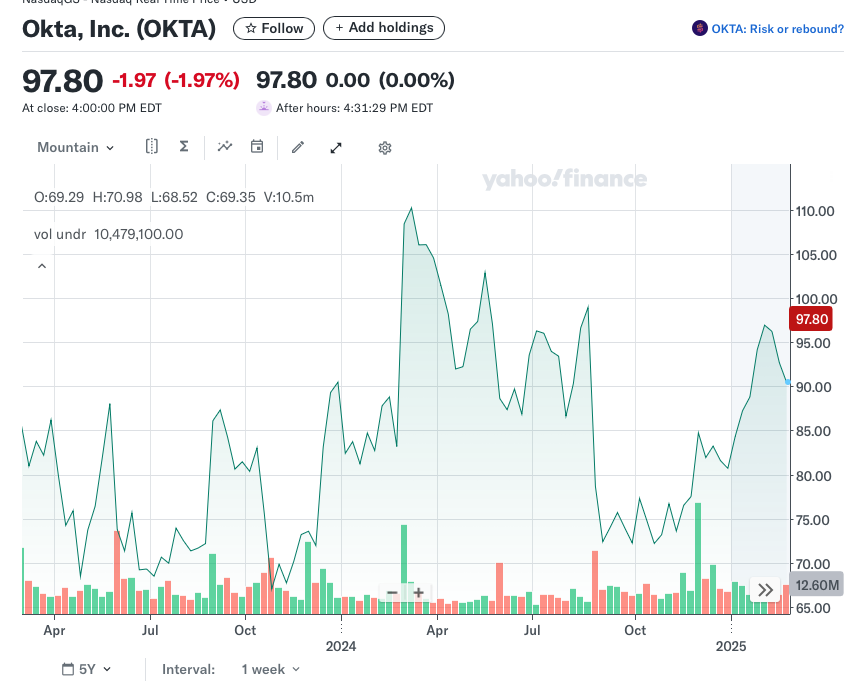
So I continue selling covered call options on my shares, sometimes decreasing the strike price, but always making sure that my total premium on these Okta shares + the sale proceeds is above the $9,779 I originally spent.
And my patience paid off, as the stock rose, I was able to start selling covered call options at higher and higher strike prices.
Today
Today is Thursday July 31, 2025. These same 100 shares are covered by an option contract -OKTA250801C100
Tomorrow is Friday, August 1. If Okta is at or above $100, I’ll sell these 100 shares that I initially bought for $97.97. Okta is at 97.80 right now so it’s a good bet that I’ll get to sell another contract next Monday.
Right now, I’ve
- sold covered call options on these same shares 8 times
- I’ve received $3,534 in option premium
- I’m likely to sell a $100 call again on Aug 4, 2025.
Remember, I’ve paid $9,779 for the 100 shares. So the $3,534 premium alone is a 36% return in a little over a year.
If they sell tomorrow, I’ll get an additional (100-97.79) = $2.21 per share capital gain or $221.
Wrap Up (1)
The Okta scenario is rare.
Often I sell a covered call option, make about 2-3% of the share purchase price in premium, and sell the shares a month later when they’ve crossed the strike price. Just as often, the shares drop on price and I either resell, if possible, or let them sit in the penalty box until the price recovers.
Again, this is important. We need to hold companies that we’ll be happy holding for a bit waiting for a recovery. And for me, I love selling covered call options on dividend stocks because they pay me while I wait.
And by using new shares of companies I already own, I’ve already done the research and am confident in the company and happy to hold the additional shares if necessary.
Best case: I have a company like Okta or T. Rowe Price or Texas Roadhouse that I like that fluctuates wildly after my first option sale. I sell 6, or 7, or 8 covered call options on the same shares and end up with thousands of dollars in premium and a few dollars in capital gain.
Most likely case: I sell once or twice and I end up with 2-3% of my initial share purchase investment as a return for taking a month or 2 of risk.
Worst case: Lemonade (ticker: LMND). I was really (overly) optimistic. I bought shares to hold long and additional shares for covered calls. I bought in 2020 and 2021 at prices between $50 and $141 per share. I had quite a few profitable option sales and then the stock nosedived. I liked the company so I held on. I watched shares drop to $31 then I sold.
Worst Case Example
With LMND, I’ve made over $13,000 in option premium.
However, by getting overly excited about the high option premium and the company’s potential, I bought too many shares of one company and I held them too long – long after my thesis had broken.
My capital loss when I sold the shares was about $35,000.
So in total, I was out $22,000 on the whole Lemonade debacle.
One bad decision can offset lots and lots of profitable option contract sales. This is not a risk-free endeavor.
Overall Performance
Over the past 5 years, I’ve sold covered calls on 90 different companies. Some I sold only once, some favorites I’ve sold dozens of times. Some like Okta, I resell contracts on the original shares several times. On others, I’ll buy shares and sell a contract, the shares go above the strike price so I sell, and then I buy more and sell another contract.
On the whole, I’m quite a bit ahead on my covered call options, but the Lemonade experience reminds me to be careful.
High growth companies may offer a 10% or more premium for a month. But high reward comes with high risk. I’ve learned to have a better balance of growth companies and steady dividend paying income stocks.
I put a very small portion of my equity portfolio off to the side and use it for covered call options to generate some income. But most of my equity portfolio is held long to allow me to capitalize on gains over many years. These gains far outweigh any gains from option premiums.
Taxes
And I also only sell covered call options in my IRA. In a taxable brokerage account we’ll pay capital gains tax on the underlying security sale and we’ll also pay taxes on the premium we’ve received. These taxes can eat into profits.
Diversification
Just like with long positions, it’s smart to diversify. I think of this in 2 ways.
First, if I have $20,000 to buy shares on which to sell covered call options, I would prefer to buy $5,000 worth of 4 companies rather than $20,000 of one company. This reduces the risk of 1 company having a more significant impact if its price craters.
I will also balance the industry and style of the 4 companies. I might buy 1 growth stock like Okta and, a couple of dividend paying financial companies like T. Rowe Price and Bank OZK, along with an energy company like Con Edison. I especially like dividend payers as I’ll collect a quarterly check while they sit in the penalty box (which all of them will at some point).
Wrap Up (2)
For those who enjoy researching and investing in companies, selling covered calls can be a nice way to supplement income. It’s important to let the majority of our long equity investments grow over long periods of time, but buying some additional shares and covering those can provide a stream of income.