
I’ve written a bit about this in a few prior posts, but I’m teaching a class next week and thought it would be a good time to revisit. I had my first bank account when I was in my teens. I had a paper route and my Mom took me to the local bank where I opened a passbook savings account. A lot has changed since then. Today, there are lots of different options so let’s take a look.
If you’d like to review the other posts on cash, check them out here and here.
We Are The Customer
Before we jump in, it’s important to remember that we are the customer. We should expect to be treated well and provided incentives for opening an account. After all, we’re giving a financial institution access to our money. In return we should expect things like a reasonable rate of interest paid to us, features like check-writing and possibly online bill-pay, information and educational materials that are usable to us, and most importantly no, or at least low, fees.
As a customer we need to shop around and find the best deal for us.
Requirements
What are our requirements?
I have coffee with Rich every Saturday. It seems that every week, he makes a trip to his local bank branch after coffee. I’m not sure what exactly he does there, but I can’t remember the last time I went to a bank branch. Rich and I have different needs.
And we probably need to shop around a bit to the different types of financial institutions to see what they offer before we can finalize our requirements list.
We’ll talk more about the options and features in a bit to help you decide.
Institutions
In my paper-route days, there was one choice. I went to the Beverly National Bank to open my account. It was the only bank in town. Today, there are lots of choices. Let’s talk about a few.
Big Banks
Any US city we travel to will likely have a Bank of America and a Santander Bank on any given street corner. They are everywhere. This is great for us as a customer. There is always a location nearby. We can stop in to visit our money or to use the ATM. It’s comforting to know we have a bank branch in every city.
Having offices everywhere isn’t cheap. In exchange for this convenience, we often get a lower interest rate on our deposits and we may pay fees, like low-balance fees or transaction fees. More on fees in a bit.
Local Banks
My town has a few local banks. Unibank and Milford Federal have offices near me, but I won’t see them when I travel. They operate similar to the big banks, but they are more focused on their region. Their customers are in the same state or adjoining states. They have fewer branches and may have fewer options for getting cash from ATMs.
But there are 2 potential benefits to customers:
- They often pay higher interest rates on deposits
- They know us. We’re just an account number to the big banks, but we may develop a more personal relationship with a local bank which could help us with obtaining a loan or with other financial needs.
High Yield Savings Accounts
While not truly an institution, many institutions offer something called a high yield savings account. Here’s an example from Bankrate:
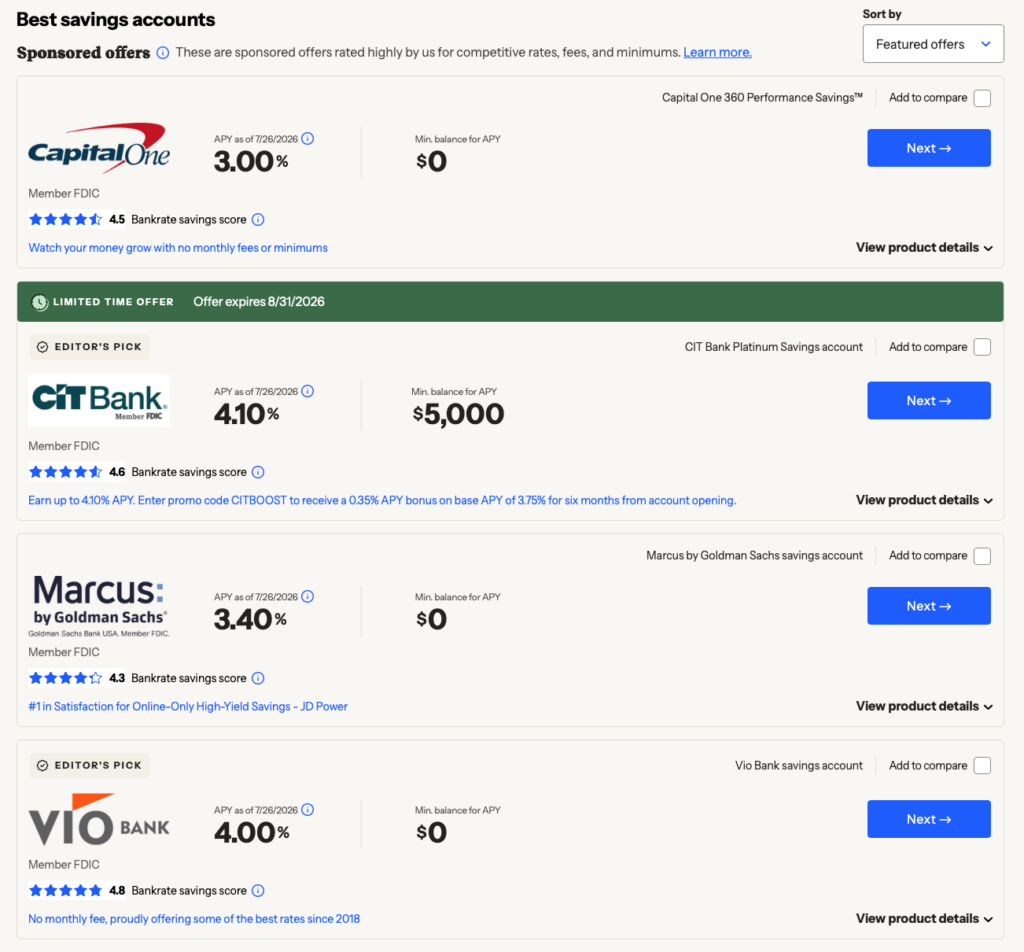
If I open an account at Bank of America or Unibank or any other big bank or local bank, I can stop by their office to do my banking. If I open an account with Vio Bank, there is no office. It’s all online. Because there are no offices, bank tellers, bank managers or loan agents, their costs are lower and they can pass the savings on to account-holders like us in the form of higher interest rates on our deposits.
The higher interest rates are great, but the services provided are limited. Often we need to have an account at another financial institution to transfer money in to open an account. So a high yield savings account may be a good supplement to our other bank account but may not replace it.
Credit Unions
Banks, whether they are big or local (regional) are for-profit companies. They have owners or shareholders who are expecting to earn profits from their ownership stake. Credit Unions are a not-for-profit cooperative. They are owned by their members. They are more like a club than a corporation.
Typically a credit union has membership requirements. We may have to live in a certain town, be a member of a specific organization or work for one of the member companies. Sometimes we need to be a family member of a current member in order to join.
In a credit union, profits are returned to the members in the form of higher interest rates on deposits and lower interest rates on loans.
Investment Firms
Bet you weren’t expecting this…but many investment firms offer cash management features that may be a better fit for us than other options. For the purposes of this discussion, we’ll stick with the big 3 – Fidelity, Vanguard and Schwab. While others may offer some services, the big 3 offer a more robust banking solution.
I have a brokerage account with Fidelity where I have my investments. I also have a companion money management account at Fidelity.
Here are some highlights:
No Fees
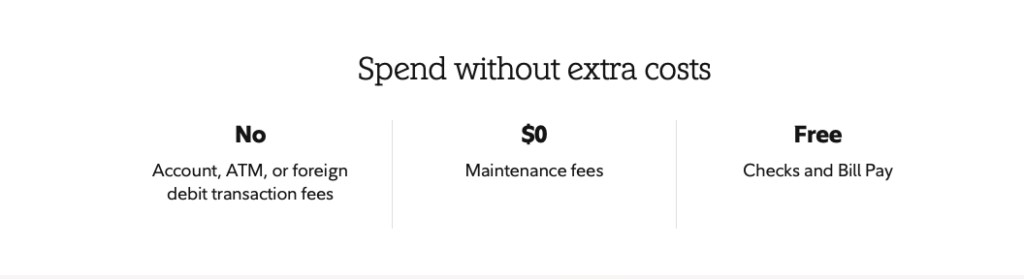
This is a big deal. Most institution will charge to print checks for us to use. Fidelity won’t. I can also enter my payments online and have Fidelity print the check, address the envelope and stamp it…all for free. No Fees!!
No ATM Fees
Fidelity does not have an ATM network.
However, I can use my Fidelity ATM card at any ATM on the planet. I withdraw money from my account using my Fidelity Cash Management ATM card and pay the fee. The next day Fidelity reimburses me for the full fee whether it is $3.50 or $5.
No Branches
Fidelity has Investor centers throughout the country, however, these are not bank branches. We can’t make a deposit, cash a check or get a loan here. If we need physical branches we may need to look at other types of institutions.
Interest rates
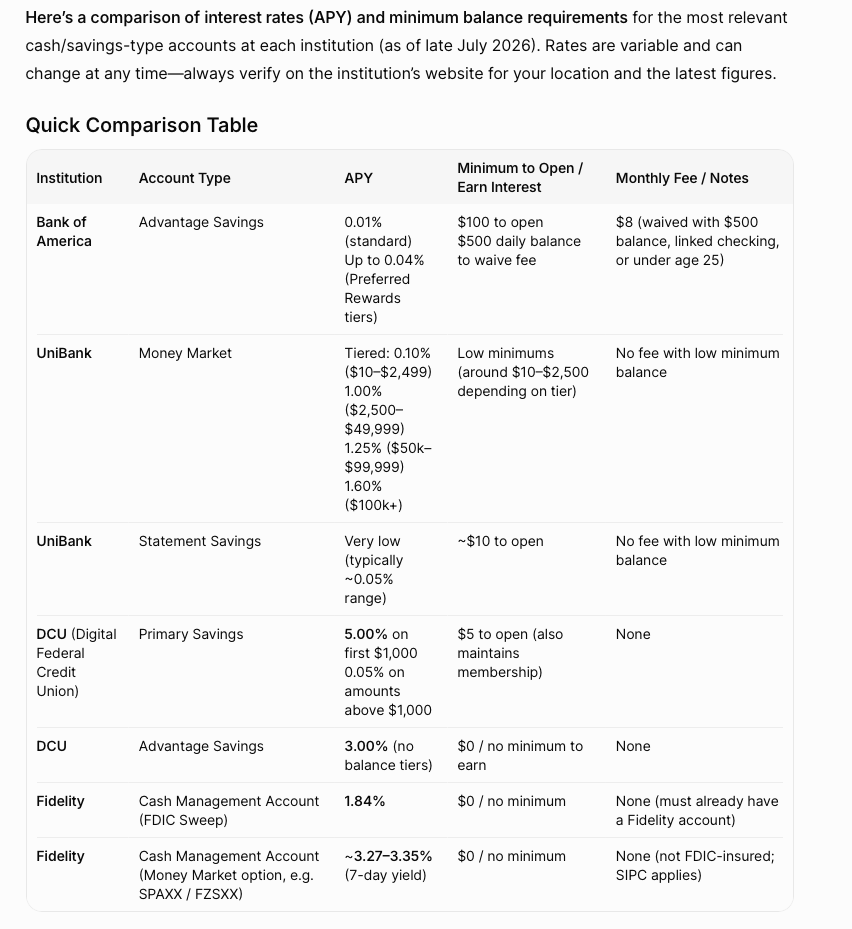
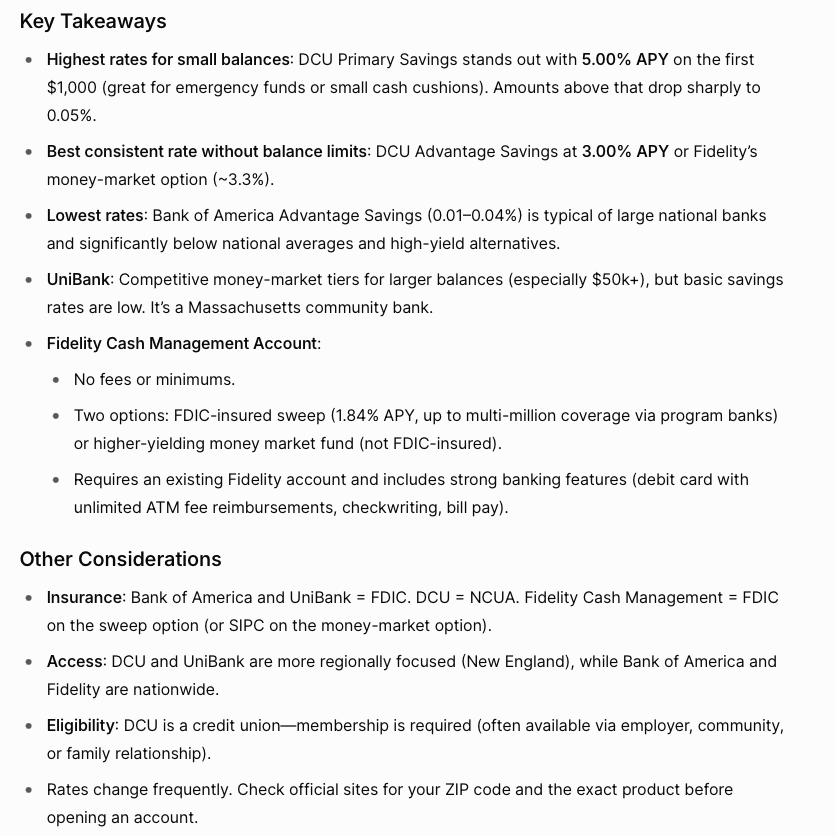
Let’s take a look at today’s interest rates across these different options. I asked Grok to do a comparison for us.
Interest Rates Matter
You may be asking whether interest rate really makes a difference. Let’s take a look.
The next 2 tables compare what would happen if we deposited $100 in 2 different accounts and left it to grow for 20 years. The first table shows what would happen with 0.01% APY (Annual Percentage Rate) interest. This is the rate Bank of America offers.
The 2nd table shows what happens under the same scenario with 3% APY.
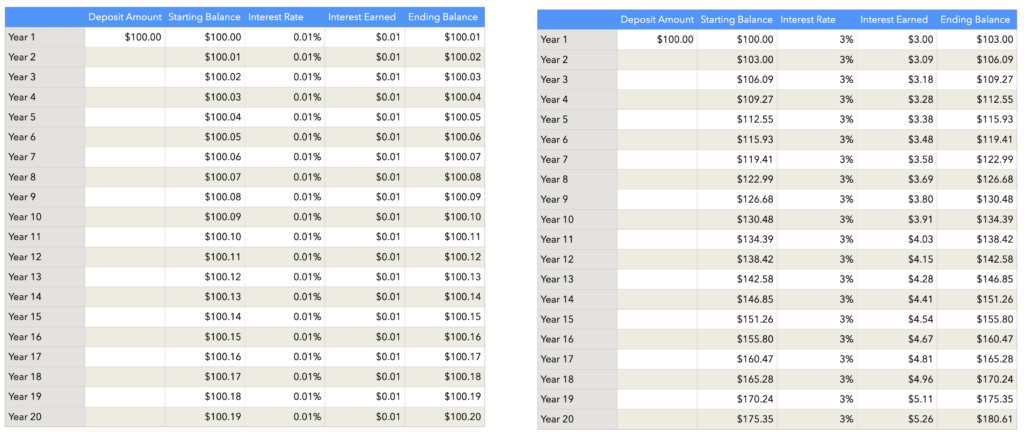
At .01% interest, our $100 has grown to $100.20. We’ve earned 20 cents. Big deal.
At 3%, our $100 has grown to $180.61. That’s $80.61 in interest for us. Our money has almost doubled!!
That’s the magic of compounding. Read more about compounding here.
And remember. This is a simple example where we put in $100 and wait 20 years. Imagine if we’re adding to our savings every week.
Here’s what happens if we add $100 every year. That’s just $2 every week in savings.
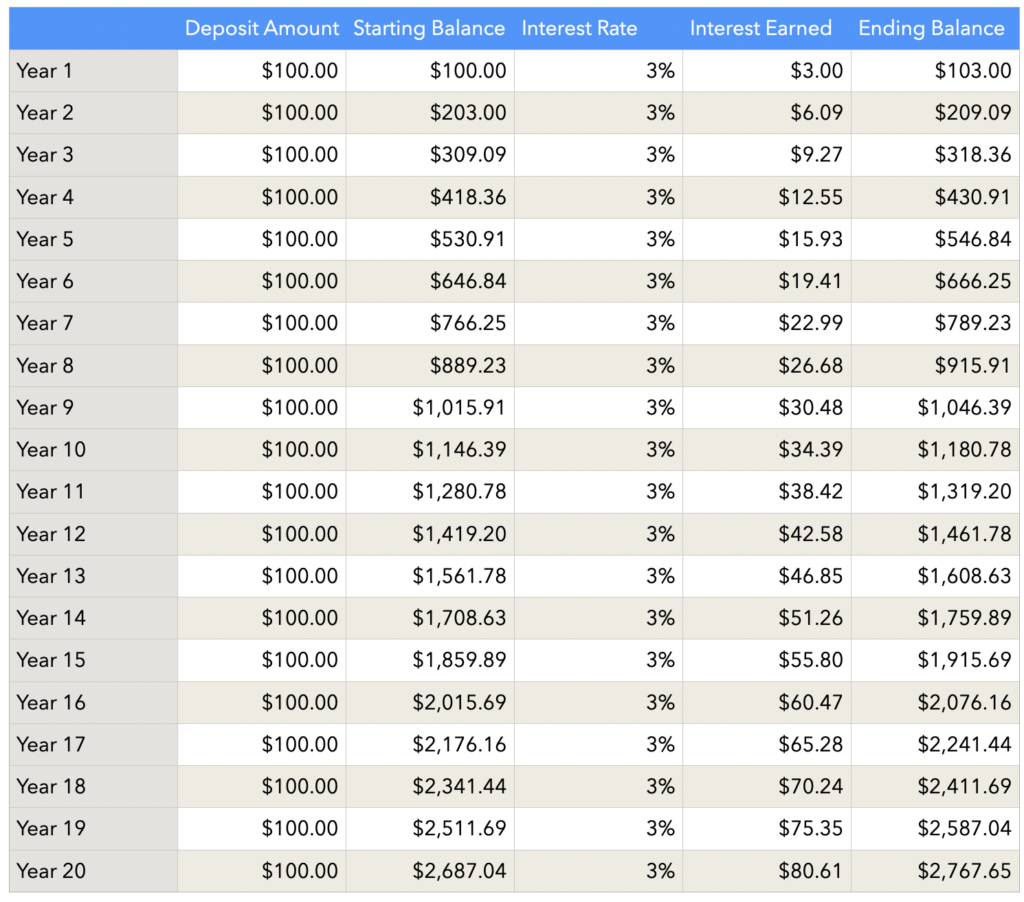
This is our money working for us.
Interest rate matters.
Inflation
When evaluating interest rates, it is important to also factor in inflation. Inflation is simply the cost of goods and services increasing. As shoppers, we know that gas and groceries and anything that we need to purchase seems to get more expensive every year. Well, it’s true. That’s inflation.
Inflation is close to 4% today and has averaged about 2% – 2.5% per year for the last 50 years or more. That means that $100 today will buy less stuff next year. If inflation is 2%, that $100 will buy $98 worth of groceries a year from now. We may be excited about earning a 2% interest rate on our savings and lose sight of the fact that we’re losing 2% to inflation.
When shopping interest rates, we’d like to beat 2% so that we’re at least keeping pace with inflation.
Safety
Is my money safe? We worked hard for it. What happens if my financial institution fails?
The Federal Deposit Insurance Corporation (FDIC) guarantees bank account deposits up to $250,000. Banks, including the big banks, local banks and all the institutions that offer high yield savings accounts are FDIC members. That means that folks like us who hold accounts there are covered. Always check for FDIC coverage. All of the institutions in the list from Bankrate specify Member FDIC.
Credit Unions are not FDIC members, but they have a similar organization called the National Credit Union Administration (NCUA). NCUA also covers accounts up to $250,000.
Fidelity, as an investment institution is covered by the Securities Investor Protection Corporation (SIPC) which covers cash deposits up to $250,000.
Before opening any account, be sure you know what, if any, coverage they have and what the limits are. this is typically posted on their website.
Alternatives
Without a bank account, we’re stuck with a number of options, all of which are expensive.
A check cashing service will cash our check immediately with no hold period, but we’ll pay between 1% and 10% of the check value as a one time fee. Imagine cashing a $100 check and only getting $90.
Cards like Green Dot or Chime can be purchased and we can load money into our account, but we’ll pay fees on every transaction.
Wrap Up
As a customer considering our banking needs, we have lots of options. It’s important that we assess our needs carefully and shop around to find the best option for us.
And the great news is that we don’t have to choose just one. We could have 2 or 3 or more. Just be aware of fees. Having 2 is fine, but if it forces us into having a low balance at one and paying a fee, it may not be a great deal.
It’s also easy to change. Often we can close an account and open a new one online. And transferring money can usually be done with a click of a button. If our chosen institution isn’t working out as planned, try another.
And don’t forget. We’re the customer. We have choices. We’re depositing our money. We should expect something in return.