
As we start to move from the accumulation phase, our working years where we are socking away money for retirement, to the distribution phase where we finally get to spend, we need to make sure we’re doing our best to protect our wealth. We want to be able to spend some, but we don’t want to run out. Today we’ll talk about how to build an income stream that allows us to spend some while our balance continues to grow.
The Distribution Phase
I’ve been retired for 6 years now. I’m getting used to it, but it was a bit disconcerting in early 2020 when I was no longer getting a regular paycheck. I had been working since I was in my early teens. I always had a paper route until I was old enough to get a real job. So, I’m quite used to a regular paycheck. It’s a little scary when that stops.
Now, I need to start dipping into that nest egg that I’ve been building for years. Sounds good, but how long will it last?
The truth is no one knows. The 4% rule is a good start. It says that at 65, we can take 4% of our retirement savings in cash to spend. We can then adjust that amount up for inflation each year and the money should last 20 years.
But, whether we decide on 4%, or a little more or a little less, we need to start taking some money out to cover our spending. Even when social security starts to pay, it’s not meant to cover all of our spending needs. It’s a supplement.
Annuities
I’ve written a bit about annuities here. They can be a great option if we want a guarantee. With an annuity, we give a chunk of money to an insurance company in exchange for either a guaranteed monthly payment, or a guaranteed rate of return.
It’s intriguing, but guarantees are not free. We pay for them. But many folks find it worthwhile for the peace of mind and the security that an annuity can provide.
Read the post for a summary of the different types of annuities, the risks, benefits, expenses…
Do It Yourself
Many of us choose the do it yourself route. And if we do, it is important to tweak our asset allocation a bit as we move into the distribution phase.
Here’s the simple reason why. As we know, the stock market is volatile. It can be up or down big on any given day, month, year, or it could even get stuck in a rut for a longer period. And while some will tell you that bonds trade opposite stocks and will be up when stocks are down, this hasn’t played out in the last few pullbacks. Bonds have been down as well, though not as much as stocks.
Because of that volatility, we don’t want money that we need to pay for groceries this week, or this month’s rent or mortgage invested in stocks or bonds. We want that money sitting in a nice safe checking account where it’s value will not fluctuate.
And if we’re careful, we can sell equities and fixed income assets periodically when the markets are up so that we’ll have cash on hand for upcoming bills.
Develop a Process
This sounds like we need a crystal ball, but we really don’t. We’re not looking to sell at the peak, we’re just looking to not sell at the bottom.
I’ve sold a significant amount of equities and fixed income so far this year. I’ve taken gains on all of these sales because I’ve been invested for years and the market is at all-time highs. But almost every single security I’ve sold is worth more today because the market has continued to go up.
But my goal is not to sell at the peak, my goal is to take some gains while the market is relatively high to build a cash reserve so that I’m not forced to sell securities when the market is low.
How Often?
This is not a full-time job. We’re not waking up every morning and checking CNBC and making trades.
I do this annually.
Somewhere around December or January, I take a look and make a plan.
This past December I took a look and saw that the market was at record highs. Price to earnings ratios (P/E) on many of my stocks were at all-time highs – especially Caterpillar – sheesh!!
I put together a spreadsheet of securities I intended to sell to take profits and to pay for my spending.
Over the next six months, I made some sales.
And again, this isn’t a situation where we watch the market and determine the best time to sell. I made the sell decision, I just don’t want to sell all at once. Make yourself a schedule. I’m going to sell in chunks on the 1st trading day of each month. The point is to prevent ourselves from selling on the worst possible day. That’s what dollar-cost-averaging is.
What Do I Do With All This Cash?
Here’s the income stream part.
This was hard to do in 2019 when CDs were paying less an 1/2 of 1 percent. Today, I have lots of options.
CDs & Treasuries
Check out today’s rates.
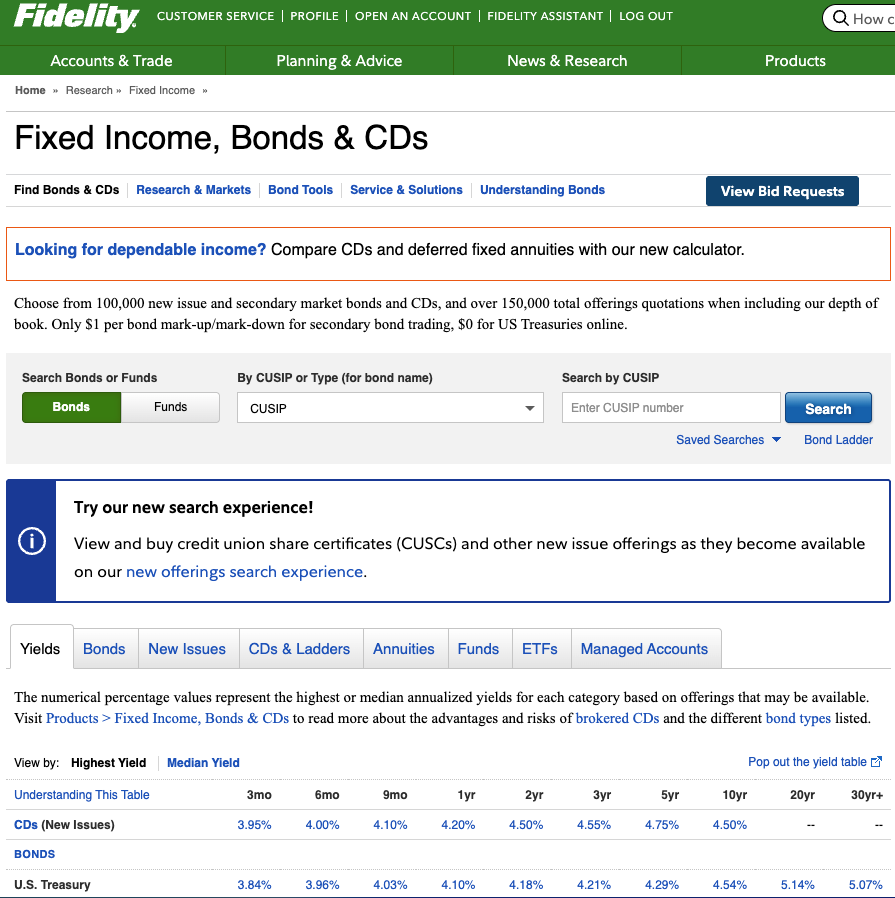
If I sell $100,000 worth of equity mutual funds and buy a 30 year treasury, I’ll get $5,070 per year for the next 30 years – until I’m 93. Then I’ll get my $100,000 back. That’s $422 per month. That will certainly help pay some bills.
And if we’re not into committing for 30 years, a nice 2 year CD, fully insured by FDIC, will get us 4.50%. That’s $4,500 per year or $375 per month for our $100,000. And again, at the end of the period, we get our investment ($100,000) back. Unlike an annuity where, in most cases, we have nothing after our payments end.
Ultra Short Bonds
So for those willing to take on a scooch more risk, Ultra Short bonds may be enticing. Bonds are volatile because they come with investment risk. The biggest investment risk is time. We’re tying our money up for a specified period and we don’t know how interest rates may change during that period. Ultra short bonds are bonds with durations that are typically less than a year and can be as short as over night.
Ultra short bonds have risks, but time is not a big risk. And currently the rates are pretty good. Take a look at this ultra short ETF.
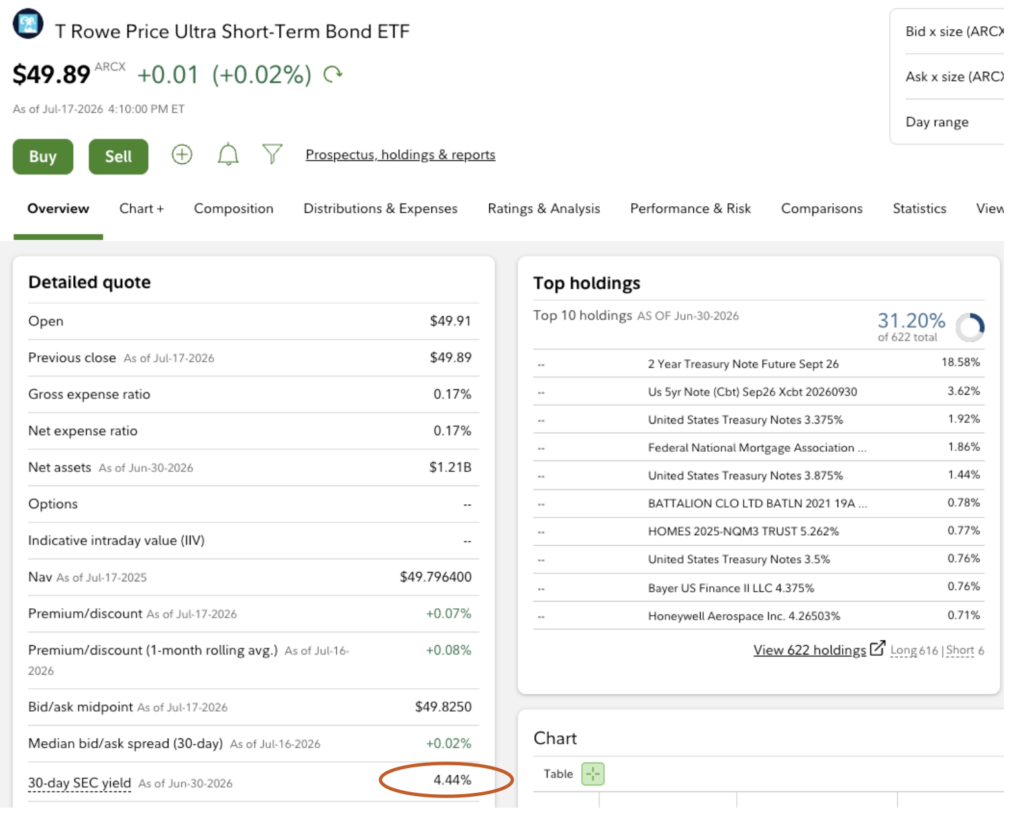
At 4.44%, it’s comparable to CDs and Treasuries but we can buy and sell at anytime.
Build a Basket
No need to just choose one. I have a basket of fixed income securities. I have some CDs, some Treasuries, some Ultra Short ETFs, and a couple of high yield and medium duration corporate bond ETFs to add a bit higher return.
The CDs and Treasuries make interest payments either semi-annually or annually. The funds and ETFs pay monthly. So I have money showing up regularly which I can move into my checking account to pay bills.
It’s just like having a paycheck.
Inflation Risk
A quick note on risk.
Our biggest risk for all of these, and especially for our cash and annuities, is inflation.
Whether we’re signing up for a fixed annuity that pays monthly, or a CD or treasury that we’re locking in for a set period of time, we need to remember that inflation averages a little over 2% per year.
That 4.5% CD that pays $375 per month looks great today, but in 2 years, that $375 won’t buy as much. Not so bad for a 2 year CD. In 2 years, we get our money back and then we can decide whether to buy another CD at the going rate, or buy an equity fund if rates are low.
Not so with the 30 year treasury. We’re locked in to $422 per month for the next 30 years. After 29 years, the buying power of $422 reduces to about $250. I still have $422, but in the year 2055, it will buy less stuff.
This is one of the problems with annuities that do not have an inflation protection feature. The dollar value looks great today, but as inflation eats away, we find we’re struggling to maintain the same standard of living.
Wrap Up
There’s a lot here, but the point is that creating the do it yourself income stream is not that hard and can provide substantial income after our paycheck goes away.
And it is important for us to manage that income stream. If we leave it to chance, and sell equity mutual funds in our 401k whenever we need cash, we may find ourselves selling in down markets which will significantly reduce the number of years that our money will last.
And at this point in our lives, this is it. The paychecks have stopped ad we need to maximize the spending power we have.
And while doing it yourself is not that hard, if this seems daunting, it may be worthwhile to work with a financial advisor. If you choose to do so, make sure they act as a fiduciary – meaning they are obligated to act in our best interest. And make sure you understand how they get paid (and how much).