
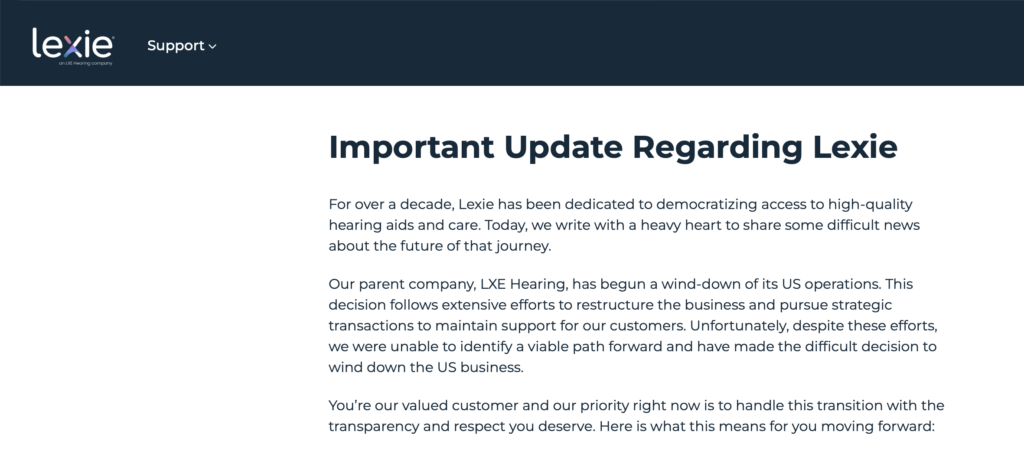
Today I was notified via email that LXE Hearing was winding down operations in the US. While LXE means nothing to most of us, it is the parent company of Lexie hearing and Eargo. I’ve owned both hearing aids (briefly). I’m on their customer list, so I got an email.
I’ve included a link to the product page on amazon for both Lexie and Eargo in the above paragraph because the sites now only show the “unwind” announcement that the LXE link shows.
What Happened?
In 2025, hearx/Lexi merged with Eargo. With the merger came an infusion of capital from an investment firm called Patient Square Capital. Sounded like good news for both companies. While there doesn’t look like there is any type of scandal involved, the company has found that it’s unable to continue US operations so it will be shutting down.
Why Do I (and you) Care?
I’ve written extensively about hearing health and hearing aids. Click here to see all hearing posts. Healthy hearing is closely linked to cognitive health. My mom is dealing with advaced alzheimer’s disease. It’s quite sad for the alzheimer’s patient and their family and friends. If wearing a device behind my ears lowers my odds, I’m all in.
That said, hearing aids are expensive. Also, I, and several friends, have had bad experiences with our local audiologists. On top of that, my $5,000 pair was not that great.
So in 2024 when my doctor chastised me for not wearing my hearing aids, I started a search for a better alternative. At that time Over-The-Counter (OTC) hearing aids were pretty new. I tried Eargo, Lexie by Bose, Hear.com and Jabra.
I won’t rehash the material from the posts, but all of the hearing aids were quite impressive, the price was half or less than traditional hearing aids from an audiologist, and the audiologists and support folks I dealt with were eager to help, which I can’t say about my local audiologist.
But while I didn’t purchase either the Lexie by Bose or the Eargo products after the trial, I recommended both as capable alternatives to traditional hearing aids bought from an audiologist.
So with the company winding down operations, these hearing aids are no longer available. But what happens to the folks who currently own them?
Apps
Both hearing aids come with a smartphone app that allows us to perform some level of programming. We can change the sound profile, filter background noise, focus on speech clarity, or increase/decrease volume. My Jabra app also attaches to my TV streamer so TV sound flows directly into my hearing aids. Not sure if Eargo or Lexie have this, but the bottom line is the app plays an important role in managing the hearing aids.
What happens if the app stops working?
While the email says the app will continue working; for how long? Is there someone at LXE international continuing to maintain it?
I would not be pleased if I spent a large sum on hearing aids and then found they were no longer fully functional.
Support
With both my Eargo and Lexie trials, I contacted support frequently. I could initiate a call through the app and I could talk to someone who would either make an adjustment for me, or tell me what to change in the app. This is especially important when the hearing aid is new, but our hearing changes over time, we may need an adjustment.
It sounds like support folks will be around for a while, but likely not more than a couple of months.
Warranty
Both hearing aids have a warranty. With the company shutting down in the US, it is unlikely that we’ll have warranty support beyond the next month or 2.
Wrap Up
Even though I no longer have either hearing aid, I was sad to see the email about operations shutting down. OTC has brought us lower cost hearing aids, better customer service, and more options.
But the model only works if we can trust that the companies will live up to their promise.
And while any company can find themselves in a position where they’re no longer viable and have to shutdown, the impact on customers is real.
Lexie B2 by Bose was a $999 hearing aid. I tested it against the Jabra Enhance 500 and my old Oticon hearing aids. The B2 was far superior to my 2016 Oticons, and was very close in sound quality to my $1,999 Jabra Enhance 500.
Had I decided on the B2s, I would be facing possible end of life for the app, warranty and support. I’d be quite unhappy as I use the Jabra app daily and I’ve had the support team make adjustments several times, and I’ve used the warranty twice (once when I jumped in the pool and forgot to remove the hearing aids, and once when they developed a defect).
So, I feel badly for the customers that have been impacted, and I feel bad that there is a smaller group of OTC choices now.
And something we often consider as an investor, but not so much as a consumer, is the viability of the companies we’re consuming from. Jabra is a partnership between Jabra, who makes earbuds and headphones and Resound Hearing, a major player in hearing aids. Sony and Sennheiser – 2 huge electronics companies – also make OTC hearing aids.
While a wind-down is uncommon, it can happen, and choosing a more financially viable company can give us some comfort that our app, warranty, and support will live on for the life of our product.
Something to think about.