I don’t sell shares of companies in which I’ve invested often. One key reason why is that I put some effort in to build a thesis before purchasing shares. So by the time I actually own shares, I’ve done some work to assure myself that I’m likely to make money on the investment. I’m wrong sometimes, but I’m committed, so I’m usually OK giving my thesis some time to play out. But today we’ll talk about when it’s time to sell a stock. Because it’s important to recognize when our thesis is broken.
The Trade Desk (TTD)
I wrote about this company as recently as April of 2026, just 4 months ago. Read about it here. I wrote:
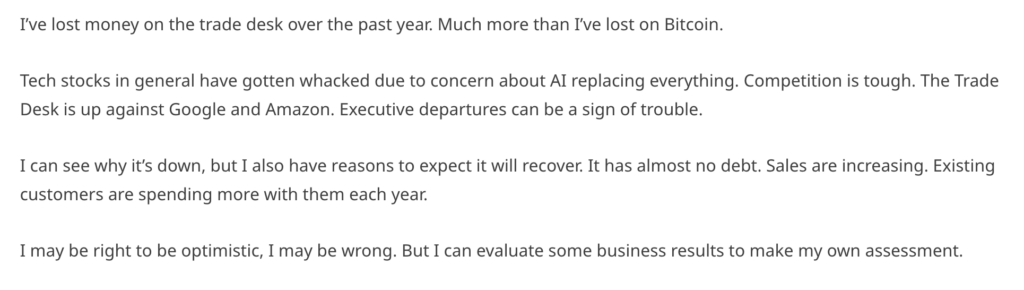
I was happy to hold on in April. I was optimistic that this was a dip that effected all software companies and that the financials supported my thesis and were a reason to hold tight. Then I sold in August. What happened?
A Disastrous Earnings Call
Last week, I was hoping for some positive earnings news. I wrote about my reasons to be optimistic, and I needed to see some of the reasons turning into more customers, more revenue or something positive to keep me interested in the company.
But in fact, the business has slowed down. Again.
Revenue was up only 3%. This is a growth company. It needs high revenue growth (20% ish) in order to justify its share price. Yes it still has a lot of cash, its customers are sticking with it, but it isn’t growing.
And the stock price was $20.09 when I wrote the post in April. After last week’s earnings, it dropped over 20% in 1 day and is now at $13.39.
AI Helped Me Decide To Sell
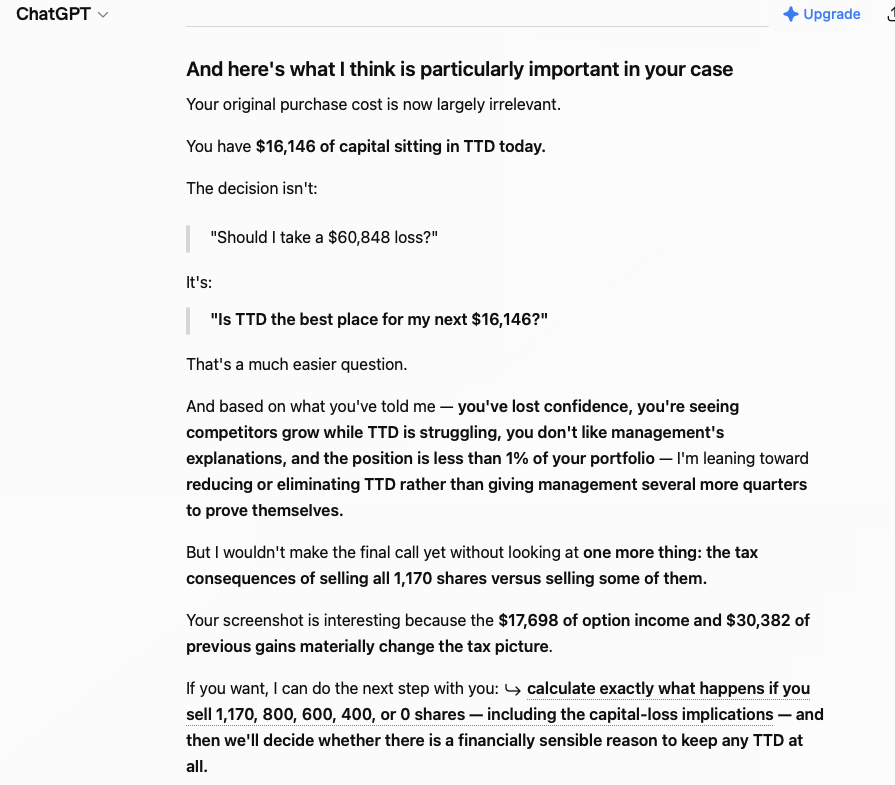
The earnings call seemed to be filled with excuses. Growth has slowed and is expected to continue to slow. I had a long discussion about this with ChatGPT. Here’s an excerpt.
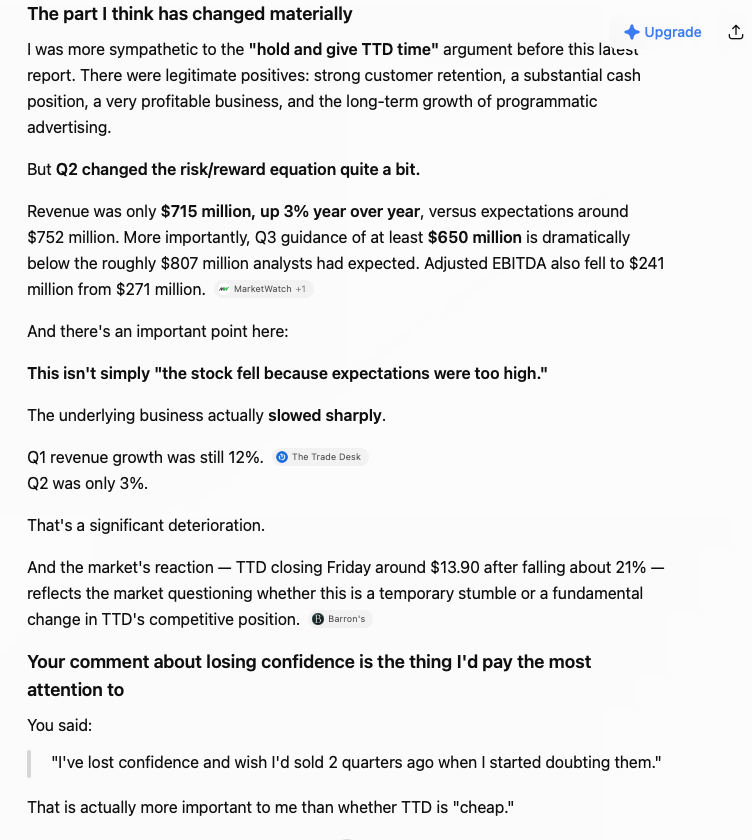
The value of ChatGPT, or any AI agent is that I can tell it what my thesis was, why I’m now concerned and have AI parse through earnings reports, and expert analysis to validate whether I’m thinking about this correctly or just responding to fear (the staggering price drop).
I had bought more shares of TTD as it had dropped from $100 to $80, and then more around $50. I was committed that it was a great company especially because of it’s large cash position (cash on hand allows a company to navigate down time – just like our emergency fund). And because existing customers were sticking with it.
So for me, it helps to have a conversation, and AI agents are pretty good at listening and are happy to go off and do a bunch of reading and research to answer tough questions. ChatGPT also told me that there were some complaints from existing customers about the user interface.
And in the end, ChatGPT keyed in on my loss of confidence and validated for me that it was justified.
Sell Sell Sell
I sold yesterday at $12.90 per share. I had a huge capital loss. Fortunately I offset this somewhat with some prior option premium and some shares I had sold back in 2021 and 2022 when the stock was up.
But I exit the position down about $21,000. Another expensive investing lesson.
What’s the Lesson?
This experience taught me a few things (for the $21,000 I spent)
- It’s important to have a thesis. Why did I buy the stock initially? TTD was a revolutionary platform allowing customers to optimize their advertising dollars. I had confidence in the message of the CEO Jeff Green, and the company managed its capital well (for example, its large cash pile, which is unusual for a growth company). And most importantly, it was growing – every year.
- It’s also important to update our thesis. In April, as part of the post I wrote, I revisited my thesis. I was still optimistic about many of the same things and I chose to look at the pullback in stock price and revenue as temporary. The important question I missed at this time was Why are Amazon and Google’s advertising revenues growing significantly while TTD’s are not?
- The biggee – Sometimes we need some help in evaluating our thesis. I was stuck on a couple of metrics that weren’t showing the whole picture and weren’t showing me performance v. competitors. I like the company, so I’m biased. Having a fact-based discussion with someone else (even if it’s not a real someone) can help our thesis evolve.
How Did I Miss It?
That’s an easy one. I’m not a professional investor. While I may ask myself one day why TTD is performing poorly, it is unlikely, especially during golf season, that I’ll log on and compare revenue figures across TTD and competitors.
How Did I Find It?
I found it through my conversation with ChatGPT. I asked questions that lead to more questions and then I had a better overall understanding of the state The Trade Desk was in.
When I went through this on my own, I kept returning to the positive factors from my thesis that still held true. The deeper conversation lead me to things I hadn’t considered on my own.
And the beauty of this was that I did not have to read one dry boring balance sheet. ChatGPT did this for me for TTD and its competitors, and provided me answers. I had to ask the right questions, but ChatGPT did the heavy lifting.
Here’s how ChatGPT put all of my info and concerns together in a final analysis.
Wrap Up
I sold.
Was this the right decision? Who knows? Only time will tell.
It’s right for me because I’ve lost confidence. I thought about selling at $20, it’s now below $13, so I’ve dropped 35% since I considered selling. I don’t want to be thinking about this next quarter when my $16k is then $10k.
I’ve taken my $16k and invested in 2 companies and 1 ETF. I think my odds are good that these 3 investments will be worth more in 5 years than TTD will.
But TTD could recover. It wasn’t long ago that I wrote a similar series of posts about Intel. Intel was a dying chip maker. I bought it for the dividend and the stock price continued its down trend and then business got so bad that they cut the dividend. I sold. I was vindicated over the next 12 months as the financial press, who had been looking at Intel as a possible turn-around story, hammered it as a lost cause.
Intel’s stock price continued to drop. And then came the US Government investment. After our President lambasted the new CEO, causing the stock price to drop even further, there was (yet another) dramatic turnaround in government strategy and the US then decided to take an equity stake in Intel. With the financial and regulatory support of the government, Intel is flourishing. Who could have seen this coming in 2023?
We won’t always be right. But we don’t have to be. Our investments that grow steadily over many years will make up for some poor choices. As long as we do our analysis, create a thesis, and keep it updated, we’ve got a pretty good shot at making some money.
The losers can be expensive, but the lessons they teach is make us better investors.