

What exactly is a saving mindset, and how will it help us to save more? This has been on my mind a bit lately and as usual, I have a couple of stories to help demonstrate what a saving mindset is and how developing one can put more cash in our pocket.
Savers
What makes a person a saver?
I look around at my wife, my friends and my family and most of us are savers. It’s easy to tell from the behaviors. My dad had a box of old nails and screws in the basement. These were harvested over many years from items that broke or things that he’d rebuilt. For years I didn’t realize that you could buy new (gasp) nails and screws at a hardware store.
Mt wife’s story is more extreme. She grew up in a refugee camp in Thailand. Amazon didn’t deliver there and there was no Home Depot down the street or Starbucks on the corner. Her first doll was made out of a coke bottle.
The environment in which we’re raised seems to play a role. You can read more about our saving behaviors and how they lead to real cash in our pocket here, here and here.
A Saving Mindset
OK, so we get it. Savers are people who see the value in stuff and put it aside because they expect they can reuse it some time in the future. As a side note, sometimes it is difficult to distinguish these folks from hoarders, but that’s a story for another day.
This saving behavior is directly linked to our feelings about money. Just like screws or empty coke bottles, money is a valuable commodity. More on this in a bit.
Here’s the story that started this train of thought.
A New Monitor
I cheaped out on the monitor I bought for my computer 6 years ago. I didn’t know much, there were a million choices and way too many acronyms so I picked the price I was willing to pay and a brand I trusted, made my purchase and went on with my life.
My wife has my 2013 hand-me-down iMac. I used it the other day and noticed that I could read text much easier. I spent some time with Grok and learned that the 2013 iMac monitor was far superior than my cheapo 2020 monitor. Imagine that!
I involved Claude as well (when my free time with Grok expired)
AI is your best shopping friend. I started with “I need an upgraded monitor” and refined with “I don’t need a camera”, “I’d like better speakers because my hearing is bad”, and “I mostly do spreadsheets and web browsing, not games and photo editing”.
Grok and Claude never got tired of my questions and requests for them to search some more.
I found my dream monitor.
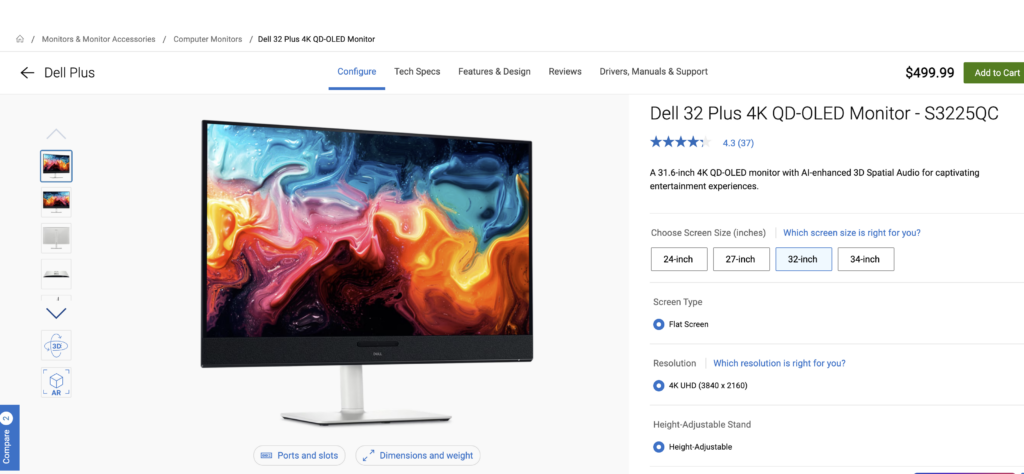
It’s a lot more than my first monitor but I figured it was worth it to actually be able to read what’s on the screen. And Grok and Claude were right on. The monitor is stunning.
Claude recommended I buy from Dell. And because I have a saving mentality, I visited Google Shopping first to see if anyone had a lower price.
Walmart did. They had it for $300 less. I chastised Claude and went back to Grok.
The New Monitor Goes Back
Ignore the $499 price on the Dell that you see in the pic. Here’s the chronology.
- Claude tells me that $899 at the Dell site is a great deal. This monitor is usually over $1,000. I add it to my cart.
- A quick check on Google Shopping tells me that Walmart has it for $599. I ask Grok to compare the specs to make sure this is the exact same monitor. It is.
- I buy from Walmart and delete the one in my cart at Dell
- The day the monitor arrives from Walmart, I visit the Dell site and see that it is now $499!!! I immediately initiated my Walmart return and am today typing this post using my new $499 Dell monitor.
Today, I’ll visit my local Walmart with the repackaged original monitor and complete the return.
Just keep It
Here’s what really made me mad.
I confronted both Grok and Claude on the price issues. Granted they could not have looked into the future and seen that Dell would drop the price, but they should have been able to identify that Walmart had the monitor for $300 less on the day I made the initial purchase.
Lesson learned here: AI is pretty smart, but we still need to fact-check.
But later when I asked about the post-Walmart-purchase price drop and doing an exchange, both Claude and Grok told me that most people, if they were happy with the monitor would just keep it.
I’m not Most People
I didn’t just keep it and the whole thing was gnawing at me ever since I saw the price drop on Dell’s website.
Of course I’m going to do a bit of legwork to save $100.
But I also chastised both Grok and Claude for their advice to enjoy the monitor and move on.
But Grok and Claude aren’t real people. Their responses come from what they’ve learned parsing through everything that exists on the internet, processed through their own algorithms to assess, assimilate and prioritize.
Big words, but essentially their responses are a reflection of our society.
How Did We Get Here?
I risk an empty tank to make sure I buy gas at the station 10 miles from home which has the lowest prices. On an 18 gallon fill-up, I save $1.80.
How could I turn my back on $100?
OK. I’ll let it go.
But I did think quite a bit about how we got here. Why is it OK to forego $100?
Where Did Cash Go?
I keep a few dollars in my wallet for emergencies (though I can’t think of an emergency that would require a 5-spot), but when do I ever use cash?
I shop with credit cards. Why not? I pay them off each month with auto-pay and I get 2% cash back on every purchase.
My golf buddies and I use Venmo and Apple pay to transfer money around to each other. One guy picks up the tab and the rest of us send our share before we leave the course.
We’ve become removed from our money.
A personal relationship with my cash
I remember my first job. It was so cool to get my paycheck on Friday. I’d walk it across the plaza to the bank we’re I’d deposit most and ask for a few dollars for spending.
And I was quite protective of the few dollars I kept aside. That was it until next Friday. I had to make it last.
And if I ran out of cash at 6pm, I was out of luck. My bank was open 9-4 Monday through Friday.
I didn’t have a credit card. There were no ATMs
I had a much more personal relationship with my money.
Today, my paycheck (when I had one) was direct deposited to my account. I never got to touch anything. It just happened.
My bills pay themselves. Every transaction is electronic. I’ve lost that connection to my cash.
We’ve come a long way from walking that check across the plaza and safeguarding our few dollars to make them last. And while that’s convenient, I think it’s changed my relationship with money.
But not a lot. I’m still haunted about getting the best price and I’ll be off to Walmart for my return as soon as I finish this post.
Habits
But I worry about my daughter’s generation and my grand kids. Not a ton. I can see the saving gene has been passed down to my daughter. And I expect her behaviors will be reflected in my grand kids. My daughter Jess got Miles (my grandson) a piggy-bank for Christmas so he can start collecting real money and experience saving. Go Jess!
But the opportunities to interact with our cash are fewer and fewer. And I wonder whether this impacts our relationship with money, and not in a good way.
New Shoes
Monday on the golf course, my golf-buddy Brett said “how do you like my new shoes?” “I got them on facebook marketplace.”
Brett said his kids gave him a hard time. They rolled their eyes and asked why he was buying used shoes. They said “we have money.”
Brett’s response was perfect: “This is why we have money!”
I love that.
Develop A Saving Mindset
Some of us have this. It may have been passed on from our parents or developed out of necessity.
But I think that those who don’t, can develop a saving mentality by spending more quality time with their cash.
And here’s an example of what I mean.
I was playing golf recently with an old friend Dave, who I hadn’t seen in a while. Dave is closing in on retirement and we were discussing strategy. Dave has a spreadsheet that maps out income, expenses, expected annual growth rates, it even takes inflation into account.
I have a similar spreadsheet, so does Mike, so does Rich, so does Brett.
This keeps us close to our money.
It’s very easy to automate our financial lives. Our pay is automated, our bills are on autopay, we just swipe or tap at the register, subscribe and save, buy now pay later…
We need to get closer to our money.
Building a retirement spreadsheet will do this. Building a budget will do this. Analyzing our spending will do this.
And for those who need radical therapy, put the credit cards aside, turn off autopay, and start using cash for spending and writing checks to pay bills.
A Not So Funny Story
A friend sent around a funny instagram post by a young lady who was in tears because she just discovered that she had to pay for all the stuff she bought with Apple Pay. She thought she was spending rewards she had earned for playing games and for always tapping “OK” to share any data she was asked for.
We all had a laugh, but automation has made us many levels removed from our money.
What’s real and what’s a game? Sometimes it’s hard to tell.
Wrap Up
Some of us are natural savers, some not.
And that’s OK. It’s our money and we should be the ones deciding how we spend it.
But the key word here is deciding. We need to proactively make decisions about our money. It’s so easy to tap “subscribe” or to click “buy”. We don’t pull out our wallet, we don’t count our cash. The item magically appears at our doorstep and we don’t even see the transaction on our credit card statement for at least a month. And that’s if we take the time to look.
Miles has his piggy bank and Dave has his spreadsheet. We need to find a way to keep that connection with our money. It needs to be important. And $100 in savings should be worth the effort of re-packing and dropping at Walmart.
ps…I’m back from Walmart and it felt Great!