

I’ve been working with the folks at Women’s Money Matters, many of whom are in the early stages of their financial journey. We’ve talked about everything from choosing a bank to starting to invest. The process has made me think a bit about a few key steps each of us can take to improve our personal finances.
Rather than trying to be comprehensive, today’s post is about a few things we can start today that will show immediate results. And we’ll stick to some of the core themes of save, protect and invest.
Save
We need an account in which to save. Ditch the 0.01% return of a Bank of America savings account and the low balance fees that come with it for either:
- A brokerage account at Fidelity, Vanguard, or Schwab
- A high yield savings account – check Bankrate for best rates
Brokerage Account?
Yes, seriously. With my Fidelity brokerage account, I have a companion cash management account. Here’s why:
- No Fees – No low balance fees, no account maintenance fees, no ATM fees (use any ATM worldwide and Fidelity refunds the total ATM fee)
- Interest rate of 1.74% currently for FDIC insured cash deposits. Option for 3.30% for a non-FDIC insured Monet Market fund
- Free checks and free online bill pay
- Direct Deposit, Mobile check deposit using Fidelity App, transfers to other Fidelity accounts or outside banks
- Fraud protection: Fidelity will reimburse you for losses from unauthorized activity in your Covered Accounts occurring through no fault of your own. Read more here.
- However, there are no bank locations to visit
I have not visited a bank in years. I have no reason to. I deposit checks through my mobile app, I withdraw money at any ATM and have the fee credited to my account, and I write checks through billpay where Fidelity writes the check, addresses the envelope and puts a stamp on it. I also have (free) paper checks. I use 1 or 2 per year. However, if you need a physical bank location, this may not work for you.
To read more about this and learn how to open a brokerage account in minutes, read What’s a Brokerage Account and How Do I Get One.
High Yield savings accounts are similar in that we can’t go visit them. But if we don’t need to visit, they’re a great option.
And there is no reason we can’t have all 3. The only caveat is that if spreading our money across 3 accounts forces us into low-balance fees, we may want to consolidate for now.
Saving
Start small
Challenge yourself to put $10 per week aside.
Start looking for savings. Maybe I could try a new cell plan from Mint Mobile or US Mobile. I switched from T-Mobile to US Mobile and saved a lot more than $10 per month.
Shop for a better deal on car or home insurance. I spent an hour on this one year and saved over $1,000.
I especially like ideas like these that get us the same stuff at a lower cost. Once we start depriving ourselves, we risk a dangerous backslide. Here’s a couple of posts with some creative saving ideas. Easy Ways to Save, Even More Ways to Save a Few Bucks, Who Wants Free Stuff?
Protect
A few basic rules:
- Start to build an emergency fund. This is money we squirrel away in a low-risk spot (savings account or a safe at home) for the unexpected financial crisis. There is no magic amount. Some is better than none.
- Be suspicious of a deal that comes to you – whether it is an investment opportunity, a loan offer or a bargain, why is it coming to you? Who is offering? What’s in it for them?
- Don’t respond – Phishing emails, calls and texts are everywhere. They want us to hand over personal information or click on something that will load spyware onto our device that will steal accounts, passwords and other personal data.
- What if it’s legit? It could be, so find another way to verify. If it’s a bill from paypal, log into your paypal account and check. Don’t click the link in the email or text.
- Passwords – You need to use strong unique passwords. This gets its own section below.
- Credit Monitoring – gets its own section as well.
Passwords
With all the info available about us, our kids, our toys, our birthdays…you name it on social media and on the web (search google for your name – it’s scary), it’s easy to guess many of our password choices. And, how are we supposed to remember them if we can’t use something that is familiar and important?
We can’t. That’s why we need a password manager. Here’s what mine does for me.
- When I log into a website for the first time, it asks if I would like it to remember the password. Yes please!
- If my password is not secure, it will suggest a replacement. How about jN6JGTQk8D3GqctTXhK4? Looks good but how would I remember that?
- You don’t. The password manager enters it for us on websites or in apps.
- A paid password manager (mine is less than $50 per year) works on windows, mac, iphone, android and works in any browser or app. We can have a different password for every website and they can all be complicated passwords and we never need to know them, or type them.
A quick note on why passwords need to be unique. Suppose I use the same password jN6JGTQk8D3GqctTXhK4 on all websites. My finance websites like Wells Fargo and Fidelity spend a fortune on data security. Some of my other favorite sites like my local news site or the cat video site I visit don’t spend any money on security. Who cares if someone gets my catvid.com password??? But if I use the same password for all sites, smart criminals will hack into catvids.com, steal their login and password list and then try them out on every financial site until they get a hit. This is why you need unique passwords.
Credit Reports
Transunion, Equifax and Experian are the 3 major credit bureaus. They gather information on all of our loans, credit cards, and financial judgements (unpaid debt, bankruptcies).
When we apply for a loan or credit card, and sometimes for utility bills, renting an apartment, or getting insurance, the provider will request our credit report to see if we’re managing our debt well. I have a whole post on this here.
Our credit report is our financial reputation.
Most importatly, we need to make sure it is correct. We can get copies weekly from each of the 3 credit bureaus at https://www.annualcreditreport.com.
Challenge any information that is inaccurate by calling the credit bureau or by calling the issuer directly – both phone numbers will be on the credit report.
Once we’ve validated that the info is accurate, set up a credit freeze at all 3 agencies. A credit freeze prevents anyone from accessing our credit report. This means we cannot apply for a loan or credit card. More importantly, a criminal who has our SSN cannot apply for a loan, credit card, or rent an apartment in our name. This is the most important and easiest way to prevent identity theft.
If we need to apply for a card or loan, we can easily unfreeze our credit report (at all 3 agencies) and then freeze it again after we’re approved.
Here are the steps.
- Create a free online account at Experian, Equifax and Transunion.
- Navigate to Credit Freeze and toggle on.
That’s it.
To unfreeze, log in and toggle off.
We must do all 3 together. It’s up to the loan or card issuer which agency they’ll contact – could be 1, 2, or all 3. If our credit report is not locked on 1, we could be vulnerable.
Continue to Monitor
Most of us won’t check our credit reports regularly even though we should.
I monitor with free services that I get through my Discover credit card, my apple credit card, and through AAA. I can sign up for free and I get a monthly email that summarizes any alerts on my credit file, and I get immediate alerts on everything from my score changing to a credit request.
Some sites like Credit Karma offer free monitoring services.
Many sites charge as much as $30 per month for these exact services. Why pay when we can get them for free?
And while we’re at it, we also need to monitor our accounts at least monthly. Look at transactions – any we don’t recognize? Are amounts what we expected? I once found my cable bill went up over $50 from one month to the next. I was shocked. I solved this by cancelling cable completely.
Invest
Once we’ve started saving and we’ve taken steps to secure our passwords and financial reputation, its time to invest. While investing can be complicated, we’ll keep this simple and strictly talk about the S&P 500 and an investment in a nice low-cost S&P 500 ETF (exchange traded fund).
The S&P 500 is a list of the 500 largest publicly traded US companies. It includes Walmart, McDonalds, Starbucks, Amazon, Apple, General Motors, and lots more. The S&P 500 has good years and bad. Take a look from our friends at slickcharts.
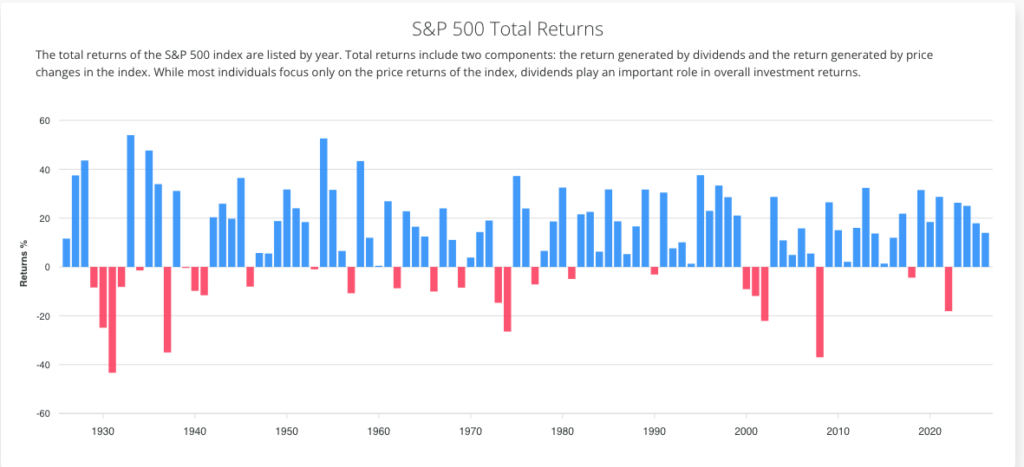
Some years it’s up 30% or 40%, some years it’s down 30% or 40%. It’s been up more than it’s been down. But it’s had 2 periods where it’s been down 3 years in a row – ouch.
But on average, it has returned 10% per year over long periods of time. That’s historical and no guarantee of future results, but the point is that patient investors have been rewarded with outsized gains while investing in the S&P 500. More about the S&P 500 here.
So we could buy a nice low-cost S&P 500 ETF like IVV.
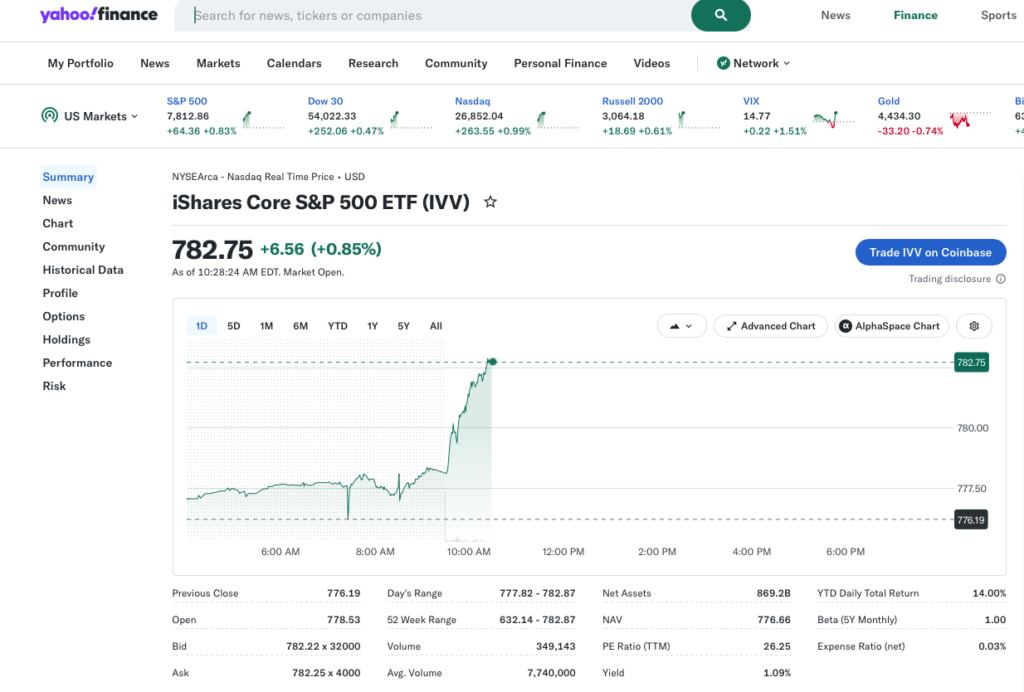
And most brokers now allow us to buy fractional shares so we can spend $5 and get a fraction of a share of IVV. We don’t need $782.75.
Why Would I take the Risk of Investing?
A picture is worth a thousand words.
Let’s talk about the $10 we’re finding each week to add to savings. This chart shows what happens if I put it in a bank savings account, v. a high yield savings, v. an investment in an S&P 500 fund or ETF that has historically averaged 10% per year.
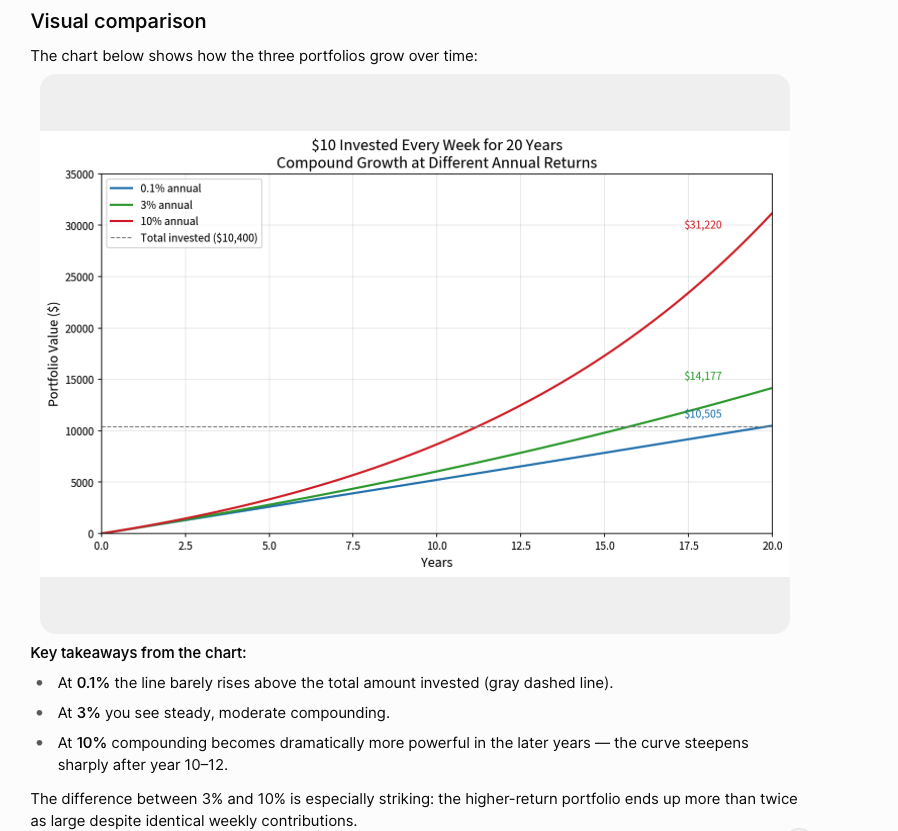
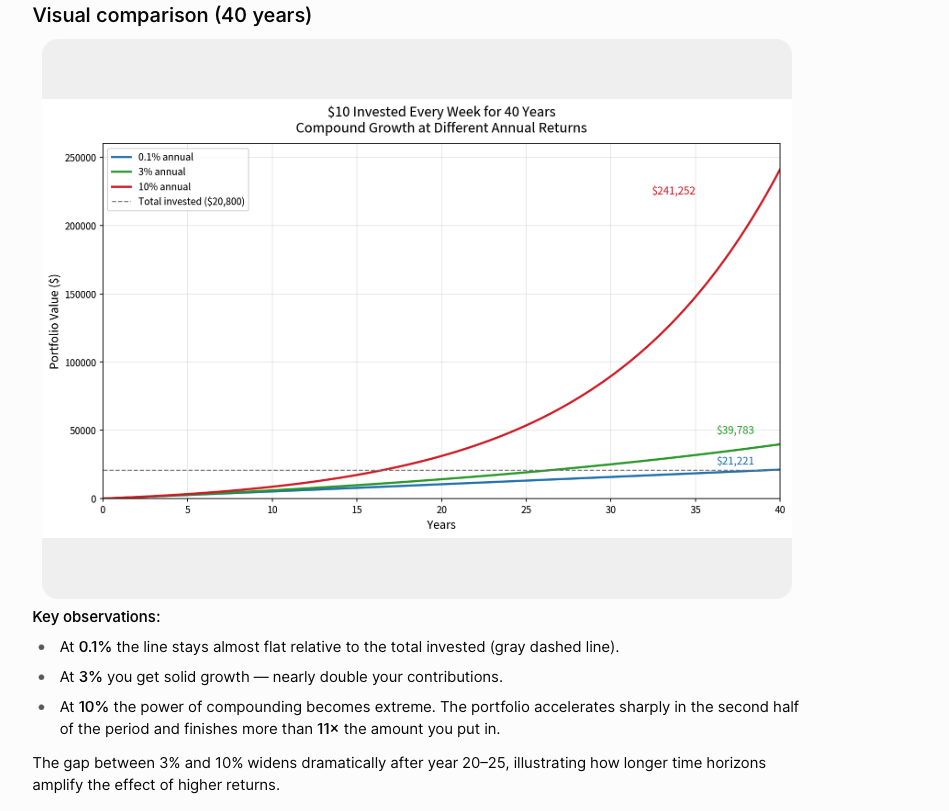
And if we extend this to 40 years, which is not unreasonable if we’re in our 20s and 30s and saving for retirement, we could have:
Investing Keys
- Compounding (interest on interest) and time grow our wealth dramatically
- Even small regular contributions can grow into meaningful sums
- We don’t invest money we need in the next 5 years. The S&P 500 is unpredictable. While it has a solid track record over many years, we know that we’ll have periods where our investments are down. We can’t have money we need for groceries, rent, or any expense in the next 5 years tied up in an S&P 500 fund.
Wrap Up
Save, Protect, Invest. Pretty simple.
It’s easy to get overwhelmed with all the information and choices. And often we miss an opportunity by delaying our decisions waiting to find the best choice, when a pretty good choice today can have dramatic results.
Our personal finance journey is a long one. We’ll learn along the way, and most of the time, it is easy and painless to change course.
So start today.