

I began my home solar journey in 2022. My first set of 22 panels went live in April 2023, and I added 2 batteries and 5 more panels in 2025. I’ve written about the journey a few times, but wanted to write a final summary and assessment.
Home Energy Credits
Up until last year (2025) the federal government subsidized home energy installations. Homeowners received a 30% tax credit for every dime spent on solar. That’s pretty cool. It’s like a 30% off sale. Those subsidies ended in 2025. Hopefully we see them again some day.
The energy credits were a huge factor in my decision to buy the first set of panels and to add 2 batteries and 5 more panels. More on the cost justification later.
Why Solar?
Electricity is expensive.
For most of our homeownership lives, my wife and I had a very small electric bill. We’d be thrilled when National Grid would send us a letter showing us we were using significantly less electricity than our neighbors. We thumbed our noses at the neighbors. What great marketing, right?
This all changed when we added a hot tub. And a pool.
Anyone who tells you a hot tub runs on about a dollar a day is lying. In New England winters it will cost you $200 per month.
My January bill after installing the hot tub convinced me that solar was in my future.
In addition, it seems like the right thing to do. Our electricity mainly comes from coal and oil. Some nuclear, and little bits of solar and wind, but largely from unpleasant (to the environment) sources. It makes sense to me to harness that energy that is assaulting my roof shingles every day, to power my home.
Panel Installation
22 panels cost me about $30,000 to buy and install. I shopped a bit at energysage and got several offers and chose the one that seemed to have the best equipment/price for me.
Energysage is a helpful site. It has tons of education, pricing, comparisons, reviews, and I got a home energy advisor that helped me with questions and helped me understand the trade-offs on the 4 offers I got.
It was about 6 months from contract signing to installation and I was lucky to have the panels live 2 weeks after install. I heard horror stories about inspections and approvals taking months.
Panel Output and Cost Savings
A picture is worth 1,000 words.
Weather varies year to year. While June is the month with the longest days – earliest sunrise and latest sunset, in 2023, June must have been lousy beach weather. May was quite sunny. Your results may vary.
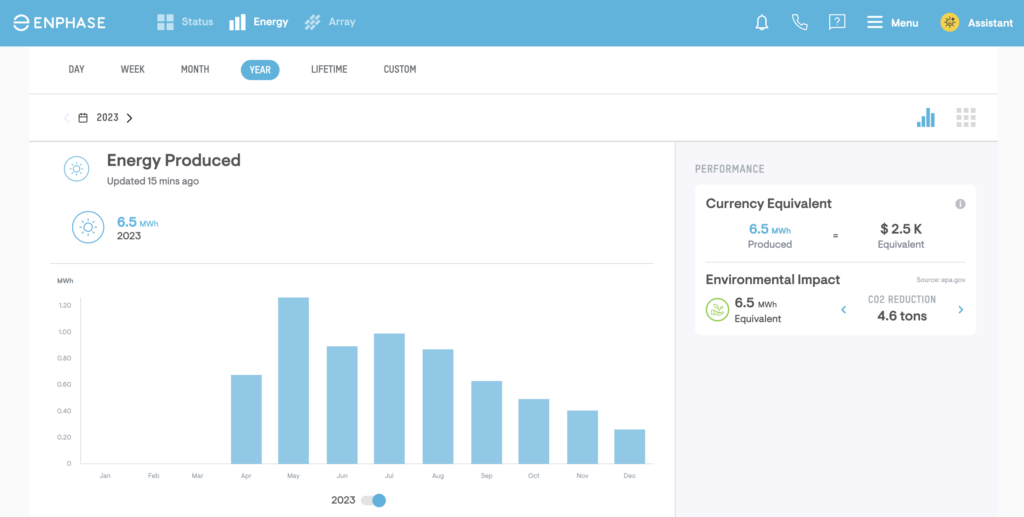
but I produced 6.5 Mega watts (that’s a lot), which would have cost me $2,500 bucks. That’s electricity I didn’t have to buy. Real savings!!
Quick Math on Solar Savings/Payoff
I paid $30,000. I got $10,000 back in taxes, so my net cost is $20,000. $20,000 / $2,500 per year = 8. 8 years. In 8.8 years, I’ll have saved more than I paid. And that doesn’t even count Jan, Feb, Mar, and half of April. A full year of panel production will be more than $2,500. So it’s closer to 6 years to pay off my initial purchase.
But that’s pretty cool. Pays for itself in 6 years or even 8 years and free electricity thereafter. The panels have a 25 year warranty so I have quite a few years of free electricity.
Not Good Enough
I’m happy, but not totally.
That hot tub us killing my electric bill in January and February when there are short days and little direct sun.
I’d like to spend less.
I also would like some protection from an outage. Our electricity rarely goes out, but when it does it is a huge pain. The heat stops because while we have oil heat, we need electricity to circulate hot water. No electric, no heat.
Good news, at that time, the 30% subsidy was in place.
More Please
I contacted another company who had given me a quote, but I had not chosen for the original system and they came out and installed 5 more panels and 2 Tesla Powerwall 3 batteries.
This set me back about $55,000.
After tax credit, I’m down to about $40,000
It’s been almost 2 years so the panels are better and more efficient. That new Tesla powerwall 3 batteries are more efficient and last longer than the prior version. Technology moves fast.
New System
My new system went live in late June 2025.
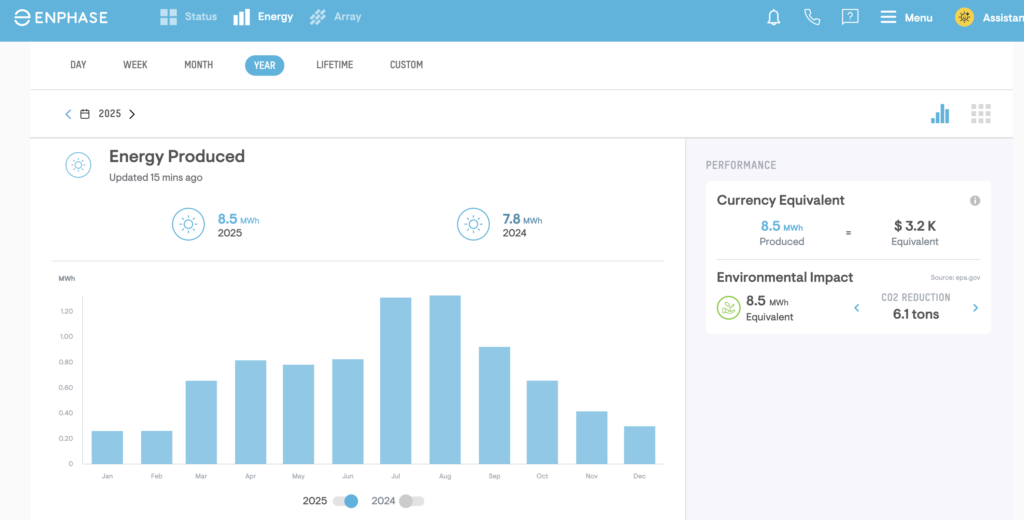
This isn’t an apples to apples comparison, but the new system cranked out 8.5 mega watts last year. The new panels were only there from July on. Wait til 2026!!
The cost justification now gets a little fuzzy but I’m generating a lot more power. My panel cost for section 2 was not that much. The big cost was the 2 batteries.
Batteries
In Massachusetts, we have an electric program called net-metering.
When I hook up my panels to the grid, I use the energy they produce and I send any excess back to the grid. At night after the sun goes down and my panels aren’t producing, I pull energy from the grid. Same is true during the winter when my production goes down.
My electric company measures how much it delivers to me v. how much I send back and only bills me for the difference.
This is fantastic for panel owners.
But it makes the cost justification for a battery more difficult. In places where there is no net-metering, there is often a reduced night-time rate. That battery lets us store up power during the day and then it calculates how to distribute that power to the home at the most cost effective times so that we never draw power during the daytime high rates, and draw only at the lower night-time rates.
But if the rates are the same and we net-meter, it’s almost as if the electric grid is acting as the battery. We only pay for the net usage.
Back-Up Power
But, solar on it’s own won’t give you back-up in case of a grid outage. Just because we have panels and the sun is out, we still go offline during an outage.
With the battery comes a switch that fully disconnects us from the grid during an outage. This prevents the power company guy from being electrocuted when we use our solar while attached to the grid. And since we’re disconnected, our battery can send power to the house.
The battery is smart and figures all this stuff out for us.
I had two 5 hour + outages last winter. I was running the lights and TV and laughing at the neighbors. I cranked the heat way up, just because.
Totally worth it.
Selling Power During High Use
25 times last year – after my new system and battery were live, the electric company had a high-demand event. I was notified via my iPhone app and since I chose to participate, I could watch the battery charge to 100% prior to the event and then discharge to 20% (the floor that I set).
The grid got some of my power and in return I got a check for $700 at the end of the year. I only participated for a month. I expect closer to $1,500 this year.
So while the battery doesn’t lower my cost, I can earn some annual income by selling power during high usage events.
Electricity Prices
Where do you think they’re headed?
Between the new AI data centers being built on every street corner and the aging US electric grid, expect your bill to go up.
This is an added incentive to think about putting some panels on the roof.
Wrap Up
There’s nothing glamorous about solar. You put up the panels, and sometimes a battery or 2, and start saving on electricity. If you opt for the battery, you’ll be able to laugh at your neighbors when the power is out and their house is dark and you’re using the blender to make margaritas.
You’ll get apps that give you nice pics and metrics to bore your friends. I can see my power consumption at any hour of the day. this is sorta useful as I can identify things that take a lot of power – like the clothes dryer – and limit their use.
But it’s a nice feeling to be energy independent. I can generate my own power and store it. If I calculated correctly, this year my electric bill will be zero. And it all comes from the sun.
The federal subsidy was nice. I got about $85,000 worth of solar equipment (including installation costs) for about $59,000.
The subsidy is gone now. That’s a bummer, but even paying full cost, you’ll get to a point where your savings will have paid off the cost of the system and you’re starting to generate free electricity. It just may take a few more years.
My panel warranty is 25 years. If anything goes wrong, the seller will fix it. That’s nice. If I save enough to recoup my costs in 6 or 7 years, then I have almost 20 years of no-cost electricity.