

I just finished an investing basics class at Women’s Money Matters and we talked a bit about stocks and what they are. It got me thinking about the things a beginning investor needs to think about when they buy their first stock.
Publicly Traded Companies
Unless we’re a private equity firm with millions or billions to spend, we’re probably going to have to limit our search to publicly traded companies. Fear not though, there are over 4,000 publicly traded companies in the US alone.
A publicly traded company is a company whose shares trade on an exchange like the New York Stock Exchange (NYSE) or the National Association of Securities Dealers Automated Quotes (NASDAQ).
To trade on an exchange, a company decides to go public. This simply means that the company needs money to grow so it has decided to divide ownership of the company up into shares and keep some and sell some to the public. There is an Initial Public Offering (IPO) process, after which, the shares are listed on an exchange and can be bought and sold by individual investors like you or me.
Some popular public companies in the US are McDonalds, Starbucks, Nike, Microsoft, Amazon, Netflix, Verizon, and Alphabet (the parent company of Google).
How to Choose
We have $10 burning a hole in our pocket. We could buy a fancy purple non-coffee drink at Starbucks or we could become a part owner of a major US corporation. Hmmm?
Let’s say we decide to forego the week’s serving of sugar in one cup and buy a stock. How do we decide?
Buy What You Know
This is a strategy discussed by Peter Lynch in his book One Up On Wall Street
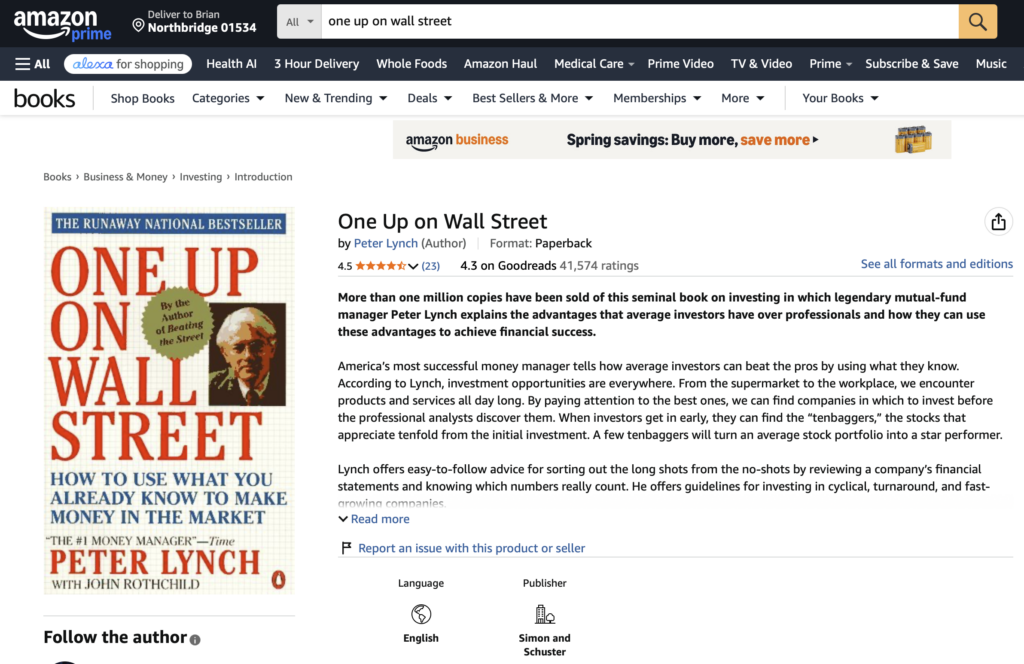
One Up on Wall Street is a must-read. It’s a great story and has a ton of valuable information for any investor.
The average investor can beat the pros by using what they know. I won’t steal his thunder, but, potential great investments are everywhere. Do you know a company that has a product you love? Have you had consistent great service from a particular company? Are people excited about a particular product? Who makes it?
That’s a Start
This is a great way to start our search.
Back in the early 2000s, I was thrilled by a company called Netflix that offered DVDs by mail. No late fees, keep them as long as I want, drop it in the mail and I had a new one from my queue in 2 days.
It wasn’t long before I started asking myself “I wonder if I could buy shares of Netflix?“
Today, it’s easy to find out. Go to a company’s website and look for an investors link. Or go to Yahoo finance and type in the company name. Or just ask Grok or your favorite AI agent.
Next: Dig In
This, however, is just the start. The investing scrap yard is filled with companies that had a great product but that couldn’t find a way to become profitable. Many businesses fail. Most fail long before they become public companies, but all public companies are not great investments.
We need to do some research to figure out if our chosen company will be a good investment.
Important Metrics
To find out if a company is a good candidate for our investment, we need to look at the company financials. In the good old US of A, this is pretty simple. This is not always true for businesses in other countries.
But the US has the Securities and Exchange Commission (SEC) which regulates public companies. The SEC requires public companies to provide quarterly financial reports and requires that those reports are reviewed by a 3rd party auditing firm to ensure that the information is accurate.
Earnings
When we think about a business in which we’d like to invest, one of the most important factors is how much the company earns. If there are 2 pizza shops on our block and one has a line out the door and one is empty, which would you rather own?
As owners, we want a business that brings in a lot of cash.
And often, earnings will be reported as EPS or Earnings per Share. The company is nice enough to break down their huge earnings number to show us how much of those earnings are attributable to each share of the stock.
McDonalds earns $12.14 per share (Yahoo Finance told me). If I buy a share for $296.76, then my share of the company generated $12.14 in earnings.
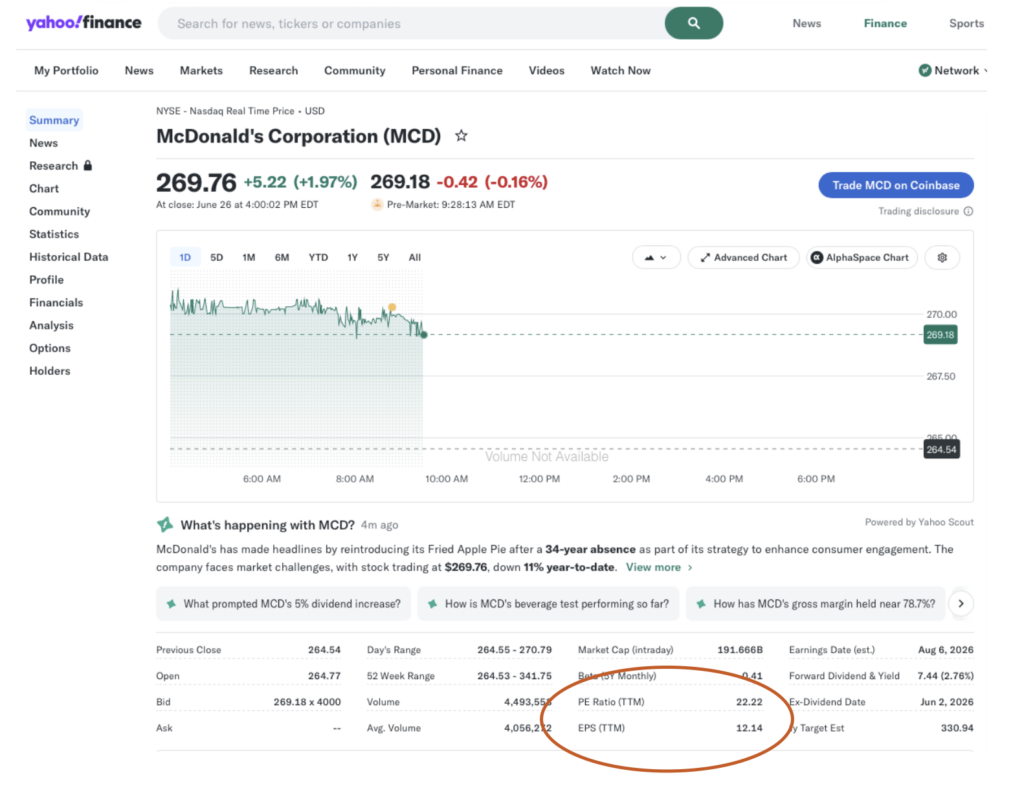
That’s better than Starbucks. Starbucks earns $1.31 per share.
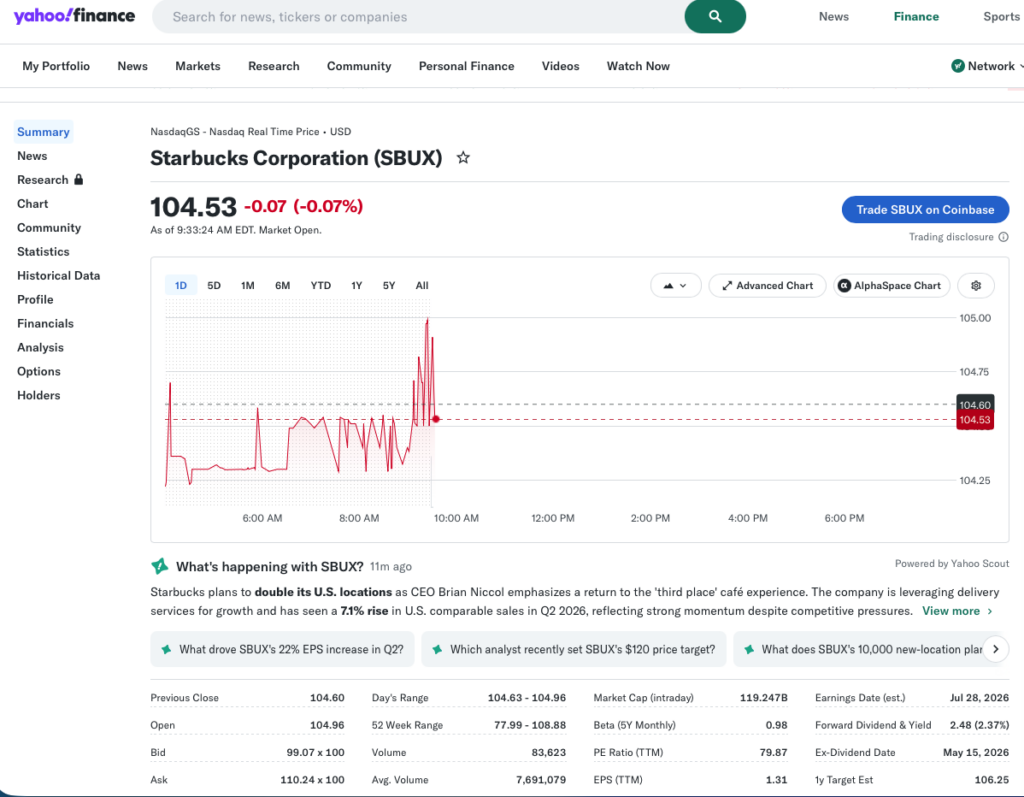
But wait, Starbucks shares cost $104.60. So it cost me less for the share so am I really comparing apples to apples?
* Note TTM = Trailing 12 months. Many metrics show the company’s results for the most recent (trailing) 12 month period.
Price To Earnings Ratio
To make comparison easier, companies also report a price to earnings ratio, which simply takes the price and divides it by earnings to show investors how much they would pay for each dollar of earnings. This allows us to compare what we’d pay for a dollar of McDonald’s earnings v. a dollar of Starbuck’s earnings.
Starbuck’s P/E or price to earnings ratio is 79.87. McDonald’s P/E is 22.22.
So now we’re comparing apples to apples. Buying shares of McDonalds seems like a better investment. We’ll pay less for more earnings.
Growth
Earnings are important. We want to own a company that earns a lot of money. But we ideally want a company that will earn more tomorrow because we’re relying on the future growth, not how well it’s done in the past.
This is hard. We don’t know future earnings. Lot’s of smart people create complex formulas to estimate future earnings, but a lot can happen that we may not be accounting for.
But what we can assess is how fast the company is growing its earnings.
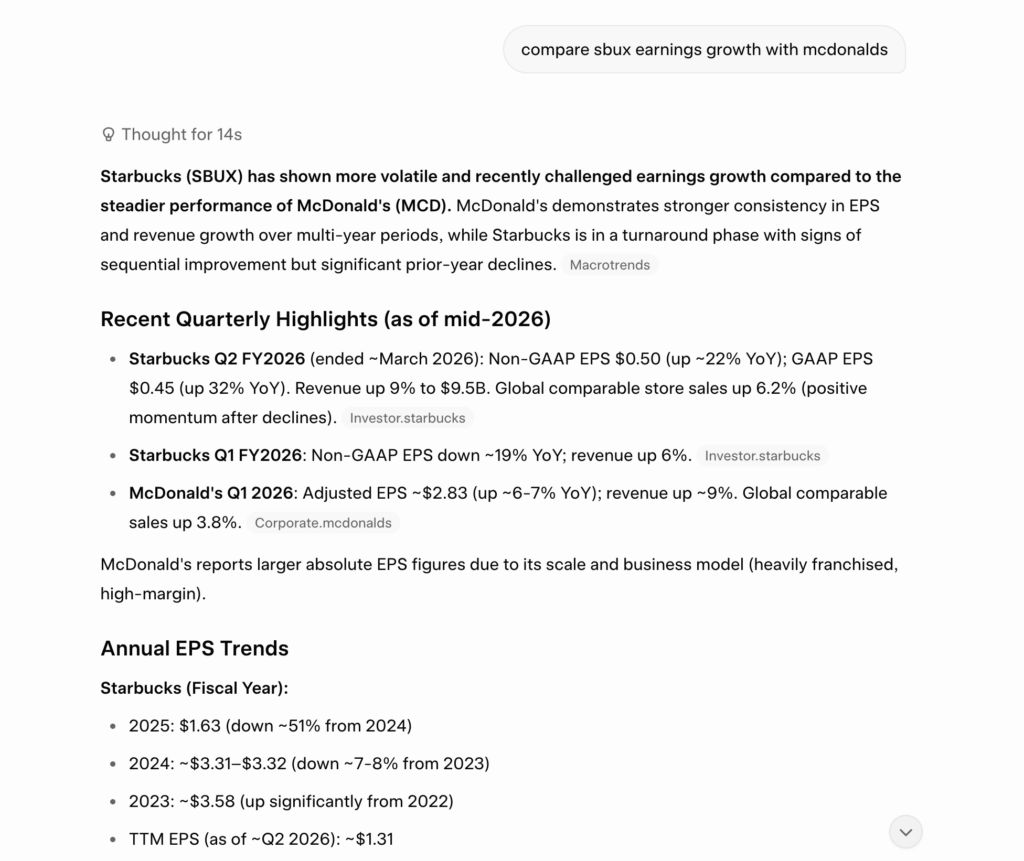
And to explore this, I am going to check in with my favorite AI assistant Grok.
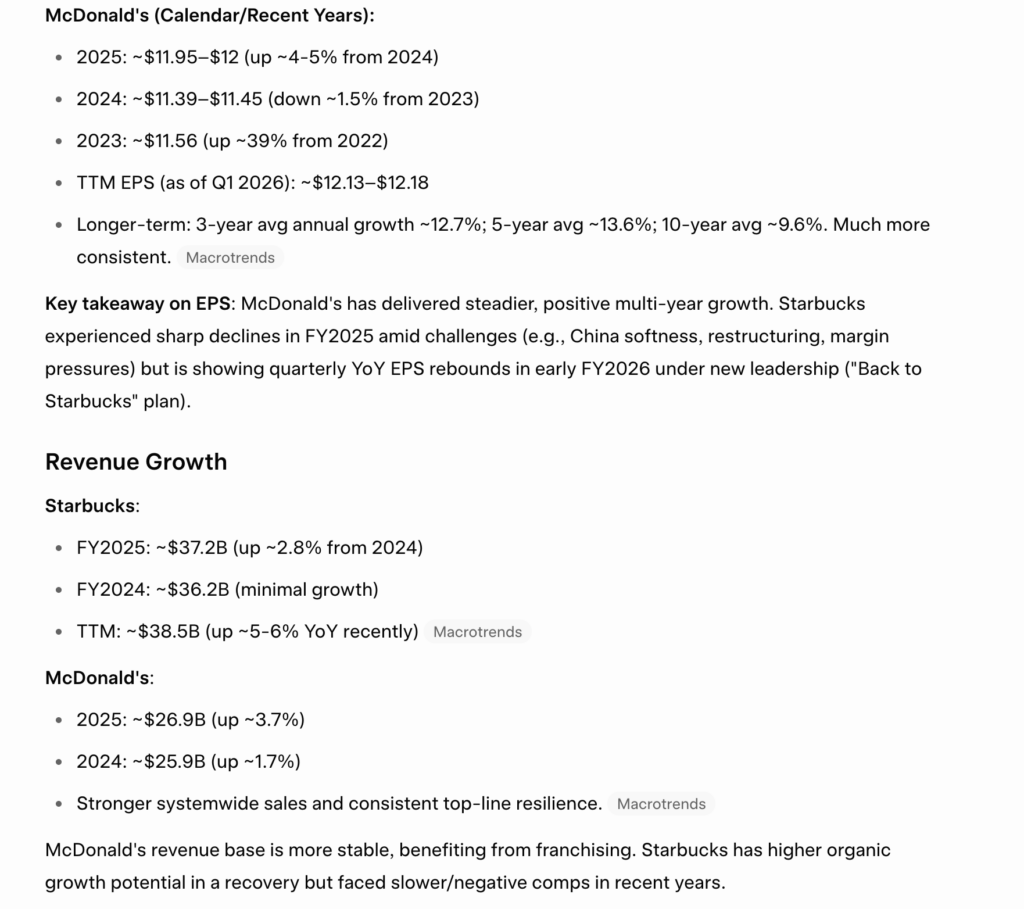
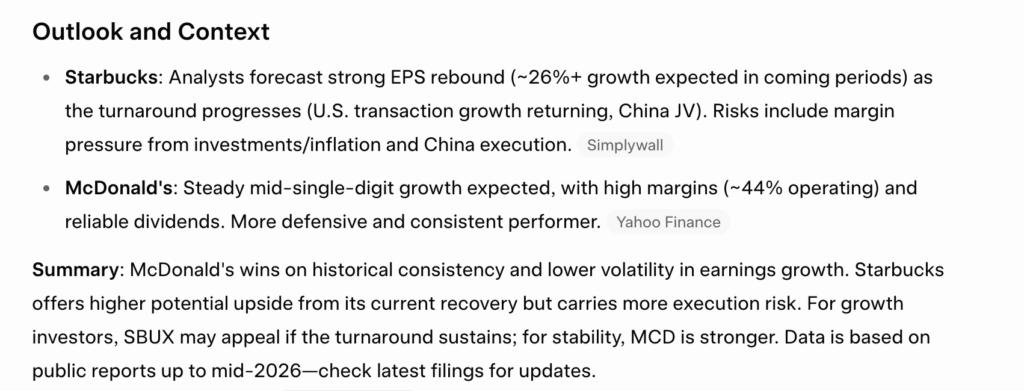
Analysts: Your Best Friend
First off, I give Grok credit for compiling this info, but what he’s doing is reviewing Starbucks and McDonalds financial reports and he’s reading what the analysts have to say about the 2 companies.
What the Heck Is An Analyst?
Many research firms hire analysts to examine publicly traded companies and the industries that they operate in. Let’s take a quick look. This is from the analysis tab in Yahoo Finance.
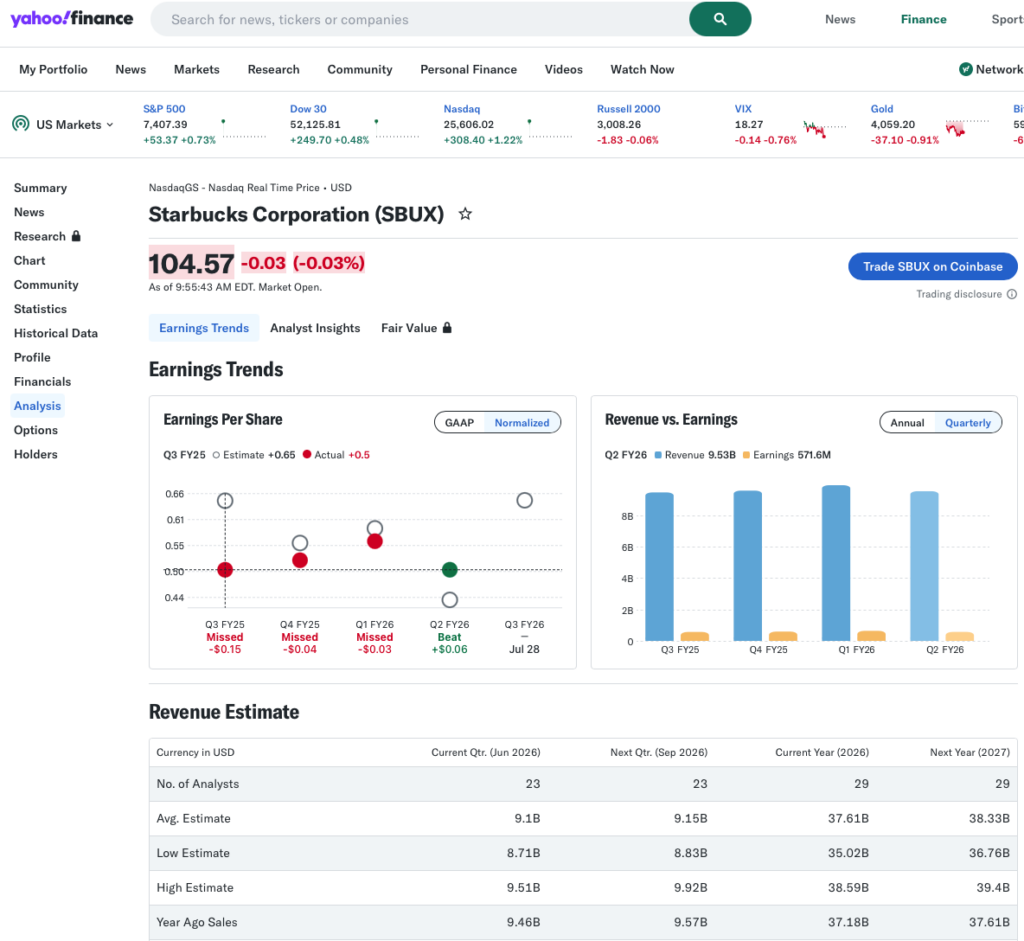
There are 23 analysts covering Starbucks. These 23 analysts are reading everything they can find about Starbucks and about the restaurant industry in the US, China, and every other country in which Starbucks operates.
And they’re also reading about McDonalds to see how the 2 compare.
Let’s let them do the hard work and we can read their results.
I got in trouble for this in school, but now it’s OK.
Analysts are typically Harvard, Wharton or Yale MBAs who spend their days in a cubicle reading volumes of data and trying to assess which companies in their industry are the best investments. Then they write up a research report that summarizes their findings.
How Do I Get a Copy of Analyst Reports?
In order to buy a stock, we need a brokerage account. Read here to find out exactly what a brokerage account is and how to open one for free.
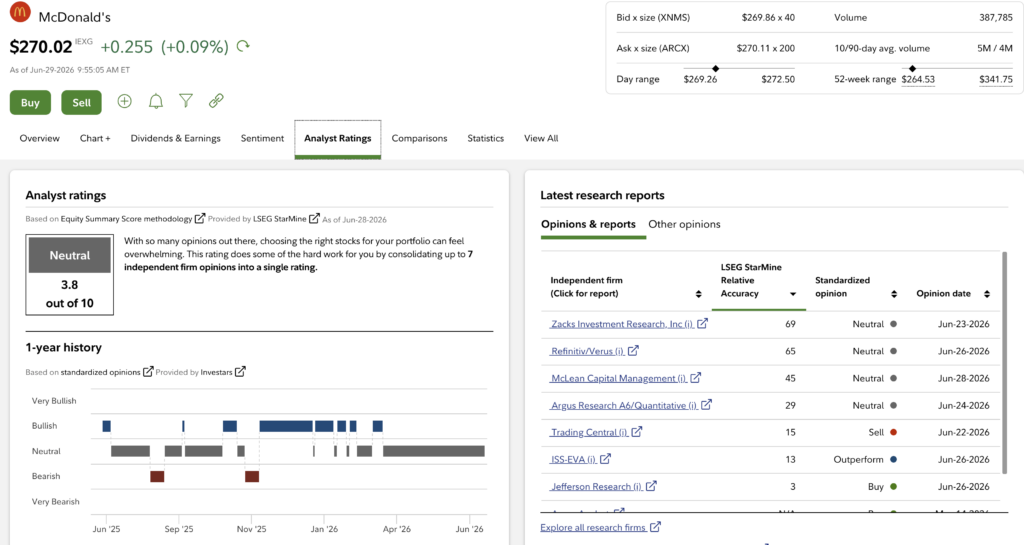
If you’ve chosen a broker like Fidelity, Vanguard or Schwab, the broker buys various research reports from these research firms and makes them available to their customers at no charge.
Questions
As we begin to read and think about these companies, some questions should come to mind.
Grok answered the first question I had. He mentioned Starbucks is in the midst of a turn-around. How’s it going? Have management’s efforts lead to higher sales? And yes, it looks like it has. That’s a good sign.
Now for all my friends at Women’s Money Matters who attended my session on investing basics, you may remember our prior session on credit. We talked about how having personal credit card debt and outstanding loans can limit our financial flexibility. I bet this is true for businesses as well. I wonder how much debt Starbucks has? I bet that could impact its ability to invest in a turn-around.
Cut to the Chase
In 2026, we can streamline this process pretty quickly.
Hey Grok. How do Starbucks and McDonalds compare on key metrics? Can you create a table for me?
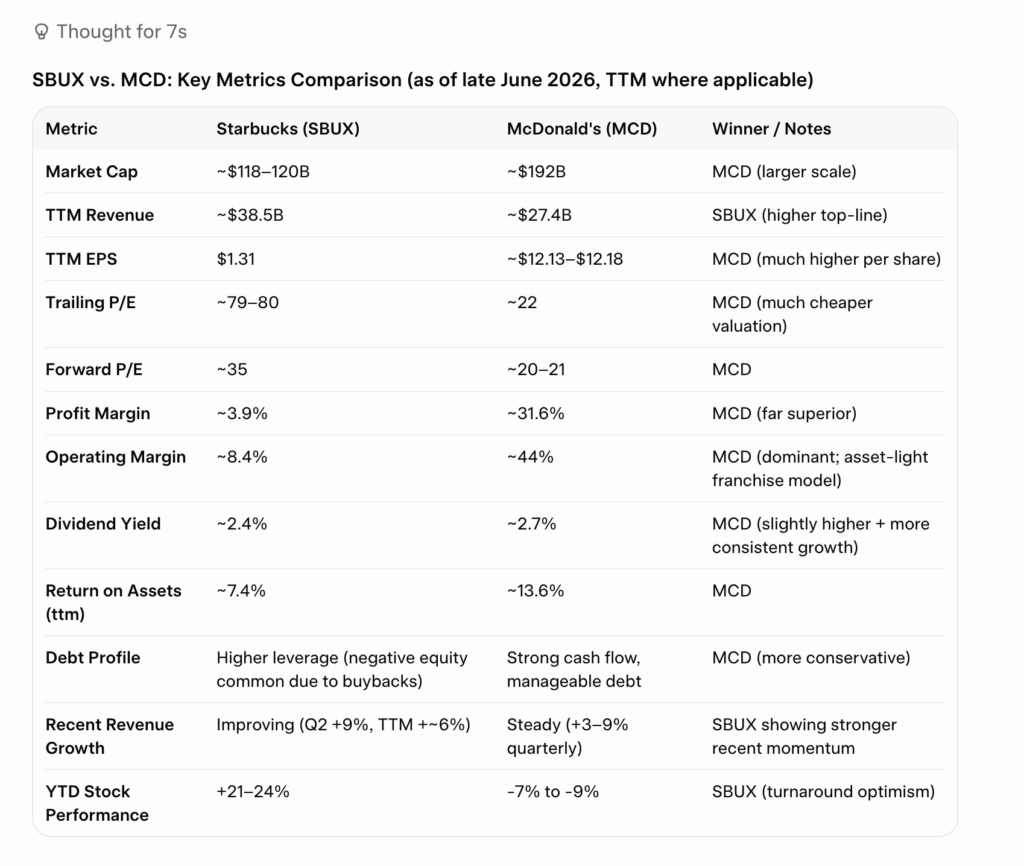
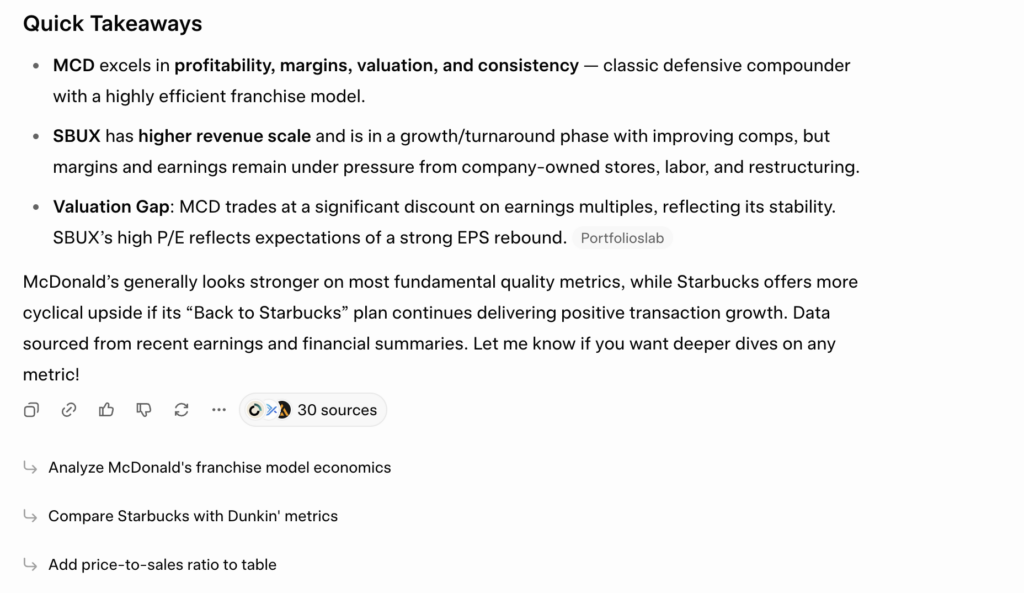
It took Grok all of 7 seconds to come up with this. And then he offered to compare to Dunkin. It’s too easy.
Wrap Up
Each of us could probably name a few great companies. And that’s a great place to start. This will give us a list of companies that we’re interested in and which we can keep an eye on by shopping or visiting.
Now we need to dig in and find out about them. Are they a great investment? Because if we are committing our money, we want to feel strongly that there is a high likelihood that the company will grow and that it will be worth more in the future.
And while Yahoo Finance and our broker provide statistics, metrics and reports, AI can be invaluable in gathering information and making comparisons.
The best advice is to get started.
Start small. Take 5 or 10 dollars, open a free brokerage account and buy a fractional share of your favorite company, or 2. Watch and learn.